What data from 4,000 sites revealed about Google’s May 2026 core update

We analyzed sites across the Raptive network, then refined the dataset to ensure a reliable performance analysis. After controlling for factors such as new installs, data gaps, and anomalous performance swings, the final dataset included more than 4,000 representative sites and 32 billion pageviews.
Google’s May 2026 core update ran from May 21 through June 2. For creators and publishers, the update reinforced a familiar pattern: search is transforming, AI Overviews are appearing more often, and the sites that perform best usually have several quality signals working together.
In Raptive’s analysis, stronger-performing sites tended to share a few traits: clearer trust and authority signals, fresher content where freshness matters, cleaner page experience, lower ad density, and pages that answer readers’ questions directly. We also took a deeper look at the characteristics of pages that earn visibility in AI Overviews and found meaningful overlap between the two.
While AI-powered search is changing how visibility is earned, the fundamentals remain remarkably consistent. Sites that are useful, trusted, current, and easy to use are generally the best positioned to succeed in both traditional search and AI-powered results.
Key takeaways
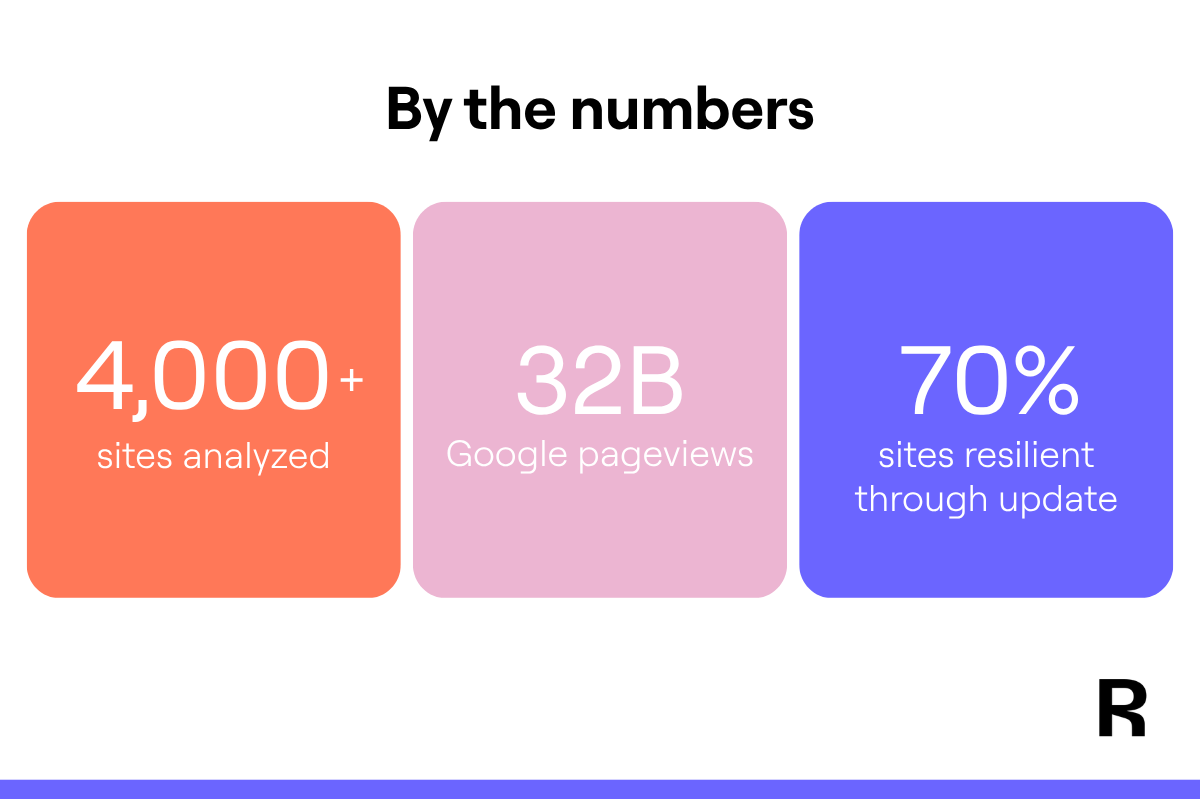
- Most Raptive sites remained resilient through the update. Across more than 4,000 sites, 70% improved or maintained performance through the May rollout.
- The strongest-performing sites shared several common traits. Lower ad density, stronger authority signals, fresher content, better page experience, more diversified audience signals, and more complete content all appeared repeatedly among resilient sites.
What we saw across the Raptive network
Raptive’s SEO team analyzed performance from more than 4,000 sites, representing 32 billion Google pageviews over the past 12 months, and saw encouraging results:
- 70% of sites were resilient through the May core update, either improving or remaining stable
- Only about one-third of sites experienced meaningful declines
- Compared to performance in the March core update, 36% of sites improved, and 33% maintained consistent performance
The update produced varying outcomes across our network, but the broader story is that most sites maintained performance. The May rollout was more nuanced than a simple network-wide decline.
Which content categories were most resilient?
While every site is unique, several content categories demonstrated notable resilience across the Raptive network. The steadiest verticals—where at least 70% of sites either improved or remained stable—were:
- Gardening
- Food
- History & Culture
- Tech
- Family & Parenting
Other categories experienced significantly more volatility, including Gaming, Deals, Travel, Hobbies & Interests, and Lifestyle.
The quality signals that mattered most
Core updates can affect sites, categories, and query types in different ways. A site may lose ground in one section while another section holds steady, or even improves.
The more interesting question was why. When we compared higher-performing sites with those that lost visibility, several patterns emerged.
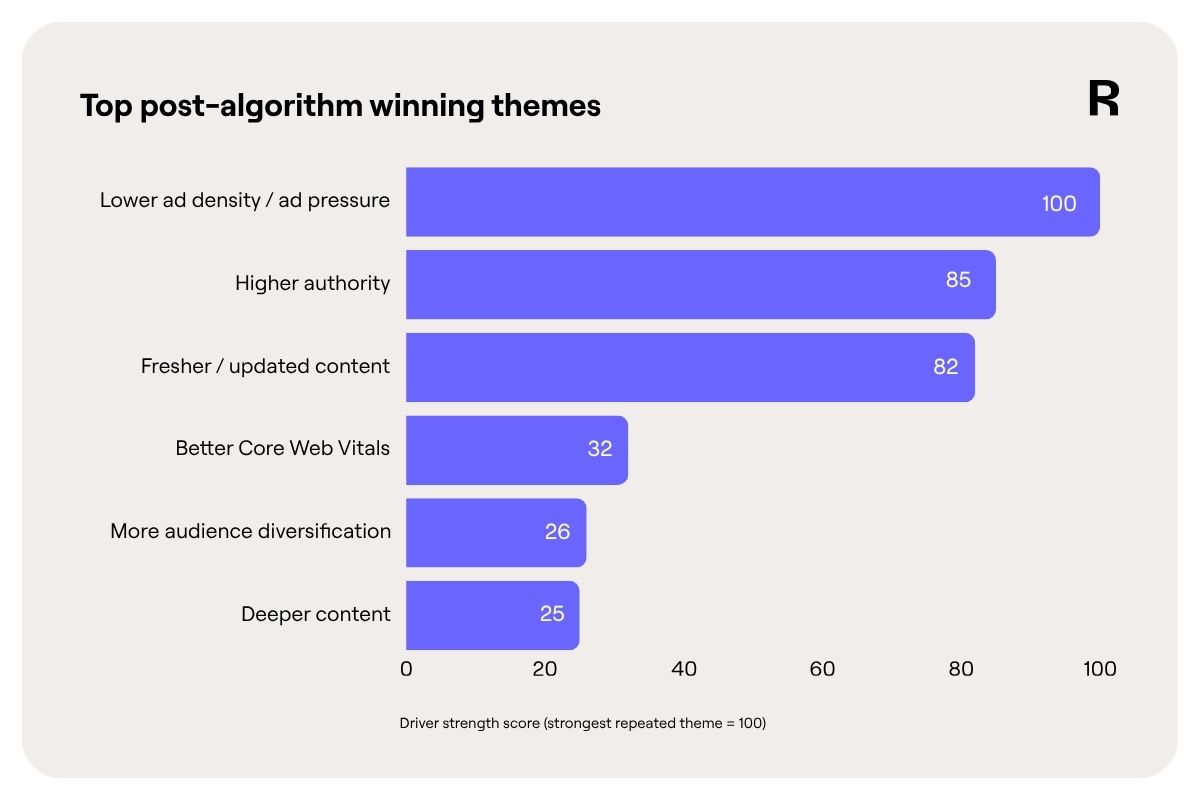
Across the May update, these are the strongest themes that emerged in our analysis.
Reader experience
- Lower ad density was one of the clearest site-level signals in the analysis. For most sites (especially in the food vertical), we recommend the medium density setting. Please reach out to our team for the best suggestions for your site if you want to make changes.
- Ensure your pages load fast and are well-organized for users. Audit your Core Web Vitals (CWVs) and ensure your pages are not in “Poor” status.
Authority and audience diversity
- Higher-authority sites were more resilient. Sites with Semrush Authority Score above 35 tended to perform better. While not a ranking factor, it reflects quality signals like natural links, brand citations, and diversified referral traffic.
- Top performers also averaged 10K+ monthly email and 40K+ monthly Pinterest pageviews, so it’s a strong signal to build traffic beyond search.
Fresh and relevant content
- Aim for an average of 7+ content updates per month.
- Keep average content age under 24 months.
- Refresh top content at least annually.
Content depth and quality
- Prioritize content that fully satisfies reader intent.
- Top performers averaged 1,200+ words per page.
- Evergreen sites with <6% of pages under 500 words performed better.
AI Overviews are becoming a bigger part of search
AI Overviews continued to expand across tracked queries after the May update. The direction varied by category, but the larger shift is that more search journeys are being shaped by AI-generated answers before readers even reach a site like yours.
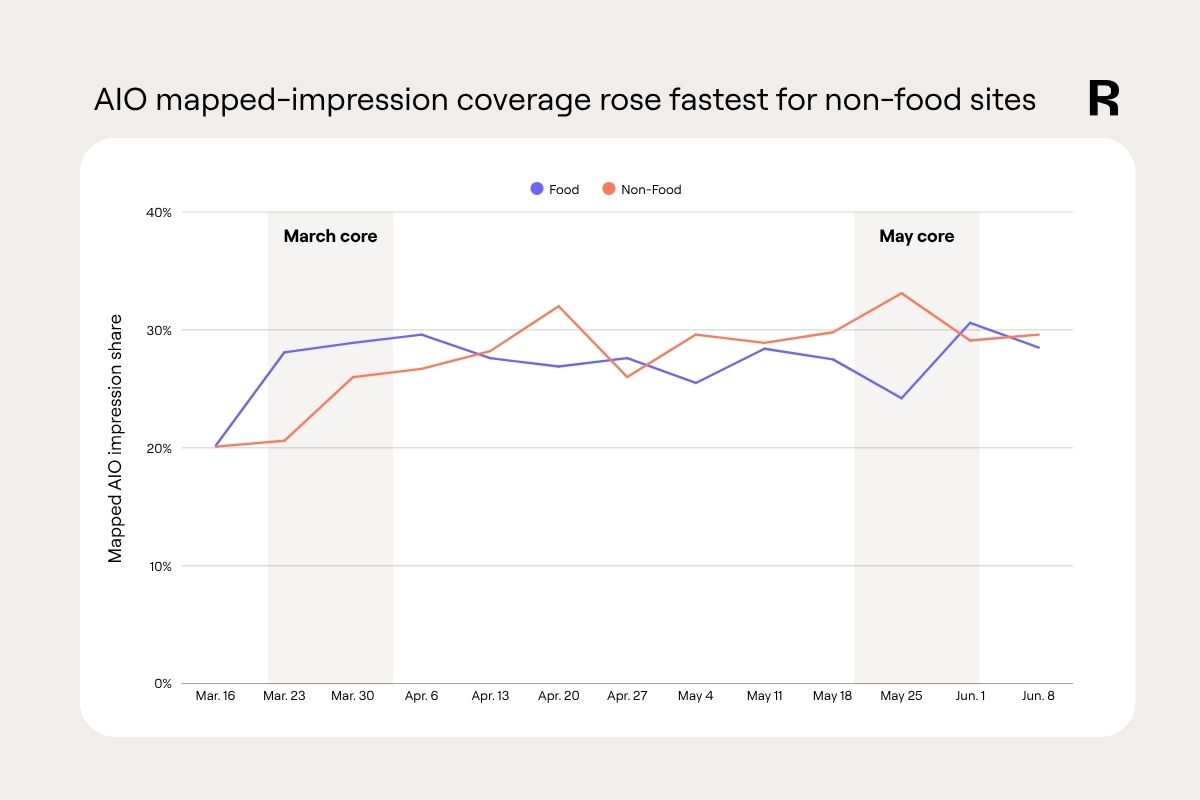
More AI Overview coverage does not automatically mean more traffic. AI Overviews can increase visibility in search results while reducing the chance that someone clicks through, especially when the answer is mostly satisfied on Google.
That’s why Raptive looks at AI Overview coverage and click-through rate together. Coverage tells us how often tracked queries trigger AI Overviews; click-through rate tells us how much traffic those impressions are likely to produce.
For creators and publishers, here’s the practical takeaway: AI-powered search is often click-negative, but absence is not a strategy. When AI-powered search appears for your topics, the goal is to win the citation and give readers a clear reason to click through.
How to identify your best AI Overview opportunities
At the page level, one of the strongest AI Overview signals is still organic strength. Google recently shared that “your existing investment in solid, foundational SEO is your launchpad for AI success,” and our analysis showed that principle playing out across real publisher data. Pages that already rank well organically were much more likely to be cited in AI Overviews.
AI Overview optimization should not start with random pages. The best opportunities are often pages that already have:
- Strong organic rankings
- Meaningful search demand
- Multiple relevant keyword opportunities
- A clear gap between current ranking strength and AI Overview citation visibility
Once you’ve identified those opportunities, the next step is making answers easier for AI systems to understand and cite. Across categories, that often means you should:
- Put direct answers near the top of important pages
- Use headings that closely match the query
- Add concise answers before deeper explanations
- Make definitions, steps, substitutions, ratios, and recommendations easy to identify
- Keep structured data accurate and complete
The specifics vary by niche. For food creators, structured data, ratings, reviews, and other trust signals remain especially important. For non-food creators and publishers, the biggest opportunity often lies within answer structure—making key information easy to find and extract before asking readers to interact with a tool, calculator, or longer explanation.
What you should do next
Our analysis identified several patterns among sites that performed well through the May update, but they all point back to the same principle: focus on creating the best possible experience for readers.
This is good news. Most of the themes that surfaced in our analysis—content quality, freshness, authority, reader experience, trust signals, and AI-search readiness—are already within your control.
If you’re looking for a practical way to evaluate your site, start with Raptive’s content quality checklist. It breaks down the same areas that recurred among higher-performing sites and can help you identify the highest-impact opportunities for improvement.
Search will keep changing, but the foundation stays the same, and the fundamentals still matter. Build a site readers trust, remember, and choose.
See other Google update recaps and analyses:
 `
`
 `
`
 `
`