What Google’s December 2025 core update tells us about quality

Google’s third and final core update of 2025 wrapped on December 29. These updates are designed to reward high-quality sites, but can cause volatility in search performance.
With each update, we analyze results using measurable, actionable factors to identify patterns and share insights with you. What behaviors were associated with sites that came out on top, versus those that were hit hard?
This analysis of Google’s December 2025 core update reinforces what we’ve been seeing over time: our foundational SEO advice still stands.
The signals most associated with positive performance
Strong performance after the December update was tied to a cluster of quality signals working together. Page experience metrics, content depth, domain trust, and content activity all played a role.
Here are the clearest patterns we saw among sites that came out ahead.
Page experience offers clues to performance
While page experience didn’t directly drive growth, it highlighted two key factors that indicated when pages were more likely to underperform.
Load time
Largest Contentful Paint (LCP) measures the perceived load speed of the elements on a page. Google’s LCP benchmark is 2.5 seconds, and our data suggests performance starts to drop around 2.3 seconds.
Historically, the weight of Core Web Vitals (CWVs) on ranking impact has varied, but this network-level trend reinforces that the December core update focused on page experience, not just your content.
Ad density
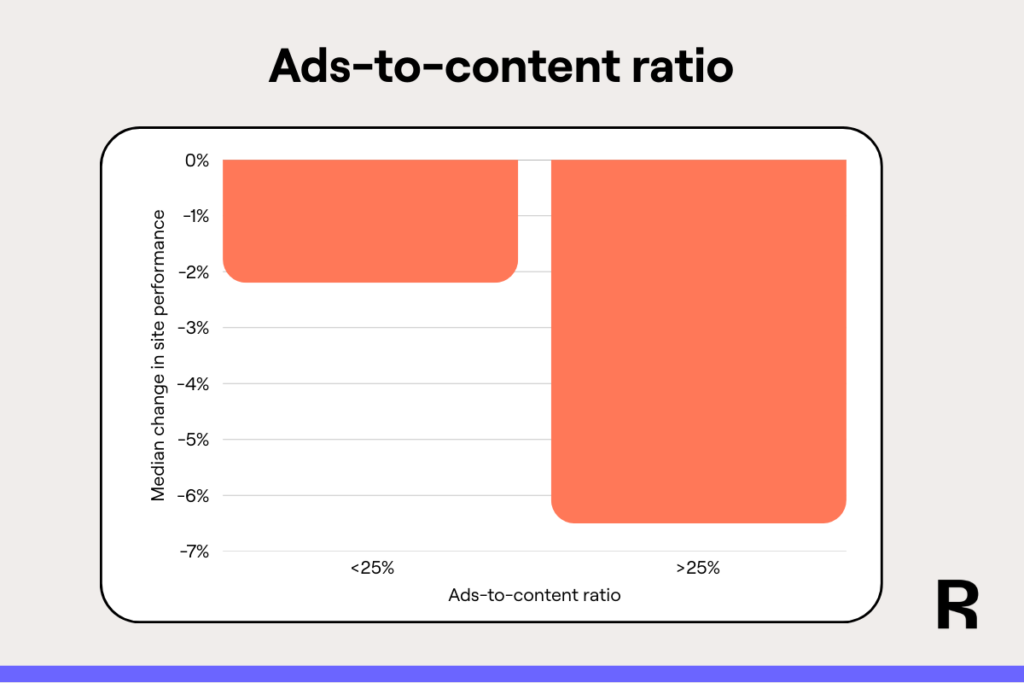
Small ad adjustments—within our recommended ad density of 20% on desktop and 24% on mobile—didn’t change outcomes. However, performance gaps appeared when the ad-to-content ratio gets too high. This can occur when density settings are over our suggested range.
Performance was four percentage points better for sites with an ads-to-content ratio of under 25%—a significant difference.
Thin content is associated with performance decline
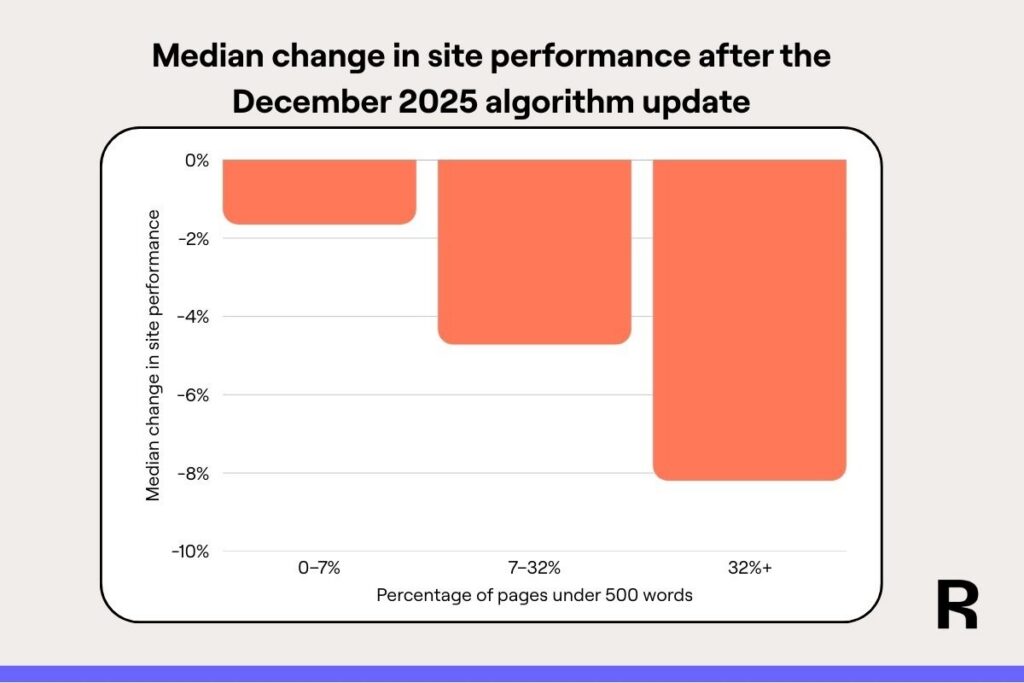
We also analyzed the connection between “thin content,” or posts of 500 words or fewer, and performance. Two patterns stood out:
- Sites where <7% of pages have 500 words or fewer saw more stability than sites where 32% or more content was deemed thin
- Higher average word count correlated modestly with stronger outcomes
This doesn’t mean that longer posts are better, but that you should avoid large volumes of low-substance pages and ensure you’re providing high-quality content that meets your audience’s needs.
Authority signals are a factor in successful content activity
Publishing or updating content is typically associated with better performance, but our analysis shows that frequent content activity didn’t help every site equally after the December update. It only started to have a positive impact once a baseline level of trust—known as authority in SEO—was in place.
In the data, that trust showed up through two related signals:
- Brand recognition, reflected in branded search behavior
- Authority, measured via third-party scores like Authority Score (AS) from Semrush and Domain Authority (DA) from Moz
To evaluate brand recognition, we measured branded search clicks. When your brand name is included in the search query, that’s considered a branded search. We calculated the sites’ branded search click percentages as the ratio of branded search clicks to total clicks.
Two clear cutoffs stood out:
- Above 4% branded search clicks: Sites showed stronger resilience and lower downside risk
- Below 0.5% branded search clicks: Sites were much more likely to underperform
Branded search reflects audience recognition and repeat demand, which Google appears to treat as a trust signal. However, it’s not something you can directly optimize for.
We saw the same trust breakpoint reflected in our authority analysis. Domain Authority is not a ranking factor, but sites that saw stronger performance from publishing or updating content typically had scores in the high 30s or higher, paired with meaningful branded demand.
At this level, Domain Authority usually reflects:
- Consistent brand recognition
- Strong E-E-A-T signals
- A track record of meeting user needs
- Ongoing freshness across top pages
Once sites crossed this trust threshold, higher levels of content activity became more effective. We recommend:
- Publishing four or more new posts per month (for evergreen, non-news sites)
- Updating around 10 or more substantive updates per month
Below that threshold, especially for sites with very low branded demand (under 0.5%), higher activity produced mixed results and often increased volatility.
This doesn’t mean that sites with a lower Domain Authority should stop publishing or updating new content. It’s that Google values quality over quantity. All new content and updates should increase value for the reader, not just provide a reason to republish with a more recent date.
Content freshness continues to play a key role
Updating existing content had the strongest positive relationship with performance. Across our sample set, winning pages had an average “content freshness” of 393 days compared to 500 days for losing pages.
These are our recommendations for successful updates:
- Make substantive, meaningful improvements that impact a page’s quality, clarity, usefulness, or relevance
- Focus on pages that are already performing well or show high potential
- Align content with the reader’s search intent and user experience in mind
What should you do next?
Every site is different. However, the December update reinforced what to prioritize across the board:
- Fix obvious page experience issues first
- Reduce excessive ad load, especially on shorter pages
- Audit thin content and consolidate where needed
- Focus on quality and relevance of updated and new content over volume
If your site is still building trust or has an archive of outdated content:
- Prioritize pruning low-value and outdated content
- Fix slow or cluttered templates
- Consolidate or improve thin content
If your site has strong trust:
- Publish and update consistently
- Invest in improving top pages
- Follow our ad density recommendations
The biggest message from the December 2025 core update is this: Great pages can’t save a weak site, but weak pages can hurt a strong site.
These results tell us that Google is sharpening its focus on quality. The details matter, but so does the big picture. In order to win, your site must have a strong balance of trust, content substance, activity, and user experience.
 `
`
 `
`
 `
`