What we learned from Google’s first-ever Discover algorithm update

From February 5–27, 2026, Google ran its first-ever Google Discover-focused algorithm update.
According to Google, the update was designed to accomplish three main objectives within its Discover platform:
- Give users more locally relevant content from websites based in their country
- Reduce sensational content and clickbait
- Show more in-depth, original, and timely content from websites with strong, specific expertise
With this update, Google is sending a strong signal that Discover is a priority for the company. This reinforces what we’ve been saying for the last year: you should be optimizing for Google Discover.
We analyzed the results of the Google Discover update and saw that big wins are possible when sites optimize for Discover:
- Travel sites saw 72% click growth
- News sites saw 34% click growth
- Smaller, niche sites across verticals saw 26% click growth
What we learned about winning behaviors wasn’t surprising, but it’s helpful for thinking about how to optimize your content for Discover. High-performing sites didn’t rely on a single factor, but a consistent combination of behaviors.
Behaviors that drive Google Discover success
We analyzed Google Discover performance across thousands of sites in Raptive’s network to understand the latest algorithm update’s impact. We started with the 3,000+ sites that give our team access to their Google Search Console data.
From there, we focused on sites with a consistent baseline of impressions throughout the update period.
This helped us account for Discover’s naturally volatile, viral behavior and avoid misleading spikes or drops. We then grouped sites by performance trends, highlighting which publishers gained, declined, or stayed steady, to uncover what’s working in Discover right now.
Discover rewards fresh content
Google Discover prioritizes new content and performs quickly. We found that pages receive over 70% of their Discover clicks just one day from publish date. Sites that consistently publish and update posts outperform those with sporadic activity.
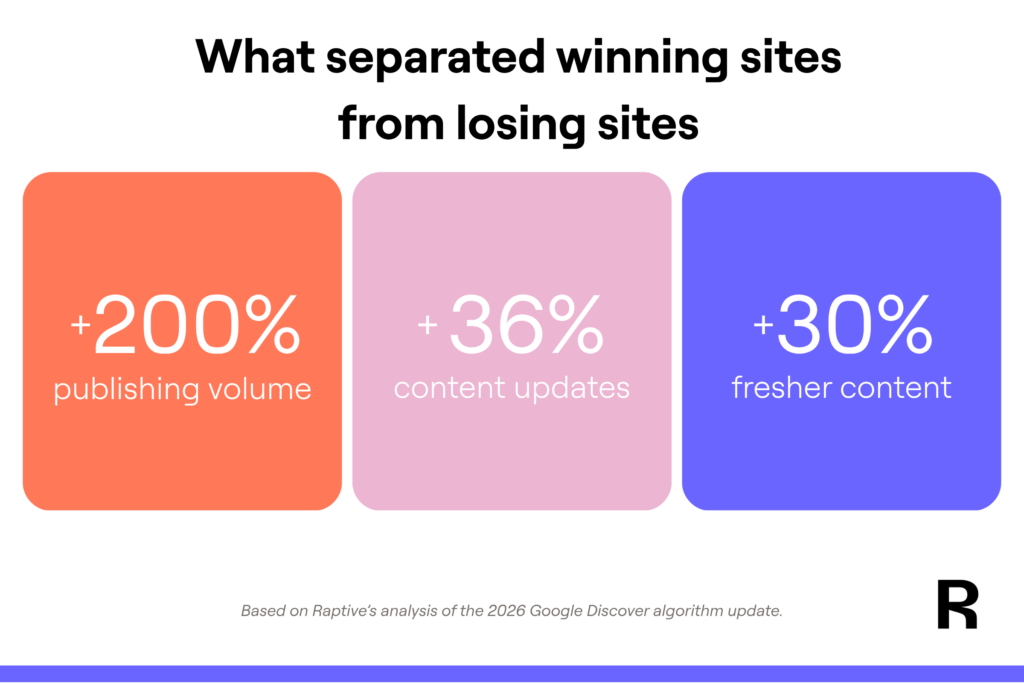
Sites that did well:
- Had roughly 2x the publishing volume of lower-performing sites
- Had a median content age of 10 months, compared to 13 months for those that saw losses after the update
Here’s our guide on best practices for creating new content.
Empty republishing is harmful
Our data consistently shows that republishes are not best practice for performance, as outlined in our refresh guide, and results of the Discover update showed no different. The more a site republished content, the more its Discover performance declined.

Audience engagement is powerful
We saw a clear correlation between sites with high direct audience engagement and those that benefited from the algorithm update.
This was especially true for email, where winning sites had about 10x higher email referral traffic. Building a loyal audience through email and referral traffic is important for both Discover and SEO authority.
Page experience is important
Sites that did well in this update also tended to have:
- An ad density of less than or equal to 20%
- Good status of Core Web Vitals, in particular Largest Contentful Paint (LCP)
Breakout performers
We categorized about 10% of the sites in our dataset as “breakout sites,” which had little to no Google Discover traffic before the update but saw clear spikes during and after it.
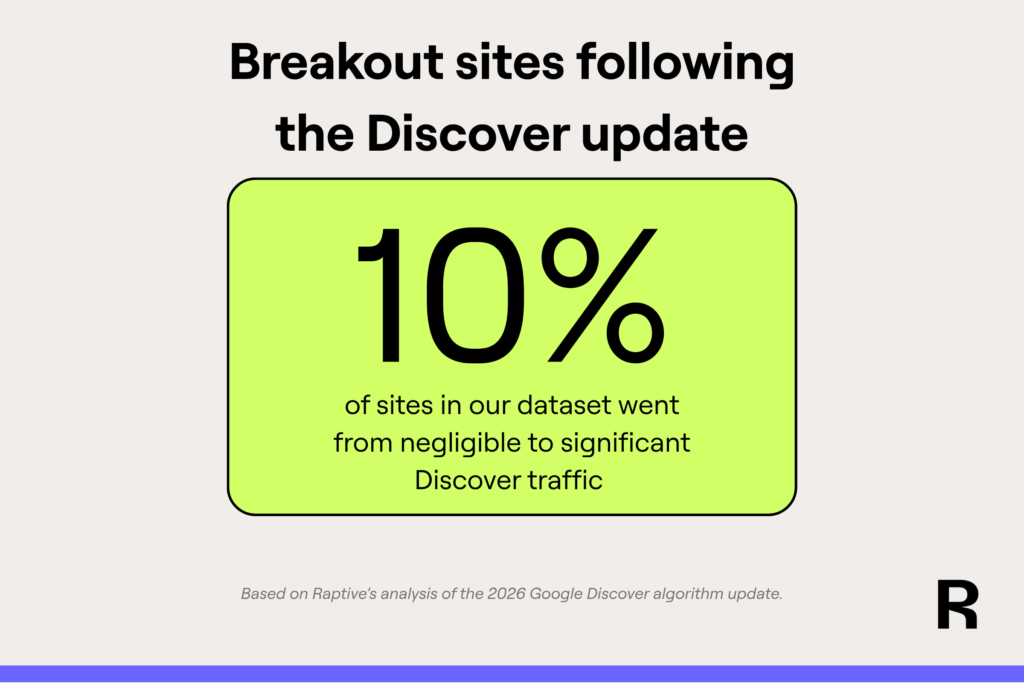
What we saw was similar to the factors we covered above, but at a higher intensity. Content velocity in particular was a driving force; sites need to consistently publish and update content to show up in Discover.
Sites that broke into Discover as a result of the update also showed strong authority signals, which suggests that Google is shifting to reward expertise over large, well-known sites.
Turning Discover data into real growth strategies
We continue to advocate that you invest time in Google Discover because we have the data to back it up. We’re uniquely positioned to understand how Discover works because of the scale and depth of our data.
With 3,000 GSC-connected sites, we have direct visibility into real-world Discover performance. Combine that with data on the publishing behavior across 5,000+ sites, and we’ve also got insight into the effectiveness of publishing cadence and updates.
Most importantly, between our SEO, performance, and engineering teams, we have the internal expertise to put together all of these puzzle pieces, identifying what actually drives performance.
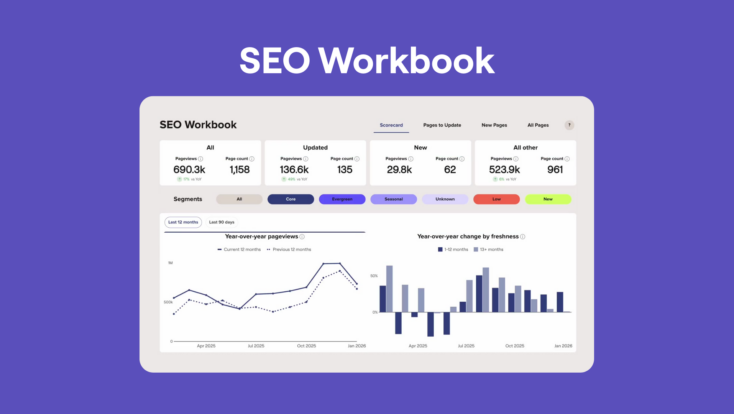
And the rumors are true—we’re turning all of these learnings into a Raptive-exclusive Google Discover Workbook, designed to help you grow your Discover traffic.
The beta version is planned for this summer, and we’re excited to get it in your dashboard.
Not with Raptive yet but interested in learning more about the Discover workbook? Reach out to us, we’d love to talk.
What this means for your Google Discover strategy
If you’re already optimizing for Google Discover based on our previous recommendations, you shouldn’t need to change your approach. Based on the results of this update, we see that valuable content is being rewarded while clickbait is being deprioritized.
The qualities that help sites perform well in SEO also apply to Discover: publish consistently, keep your content fresh, build topical authority, maintain a good page experience, and cultivate strong engagement.
Google Discover isn’t going anywhere, and our data is uncovering new avenues for you to capture a share of its traffic. As Discover becomes an increasingly important traffic source, we’ll keep sharing insights to help you maximize its opportunities.
 `
`
 `
`
 `
`