What we learned from Google’s August 2025 spam update—and what to do next

As soon as you’ve wrapped your head around one Google algorithm update and made a plan, it’s usually time for the next one to start rolling out.
Just over a month after its June 2025 core update, Google rolled out a spam update from August 26 to September 22. With core updates, the goal is to make high-quality content more visible, while spam updates focus on demoting content that violates spam policies, like keyword stuffing.
We analyzed the results of the August spam update across sites representing 95% of network traffic, and while the overall network impact was minimal, some sites felt it more than others.
Here’s what happened, what mattered, and what to do next.
AI spam and low-value content under the microscope
SpamBrain is Google’s AI-based spam detection system, and it continues to get better at recognizing low-quality content. When Google runs a spam update, it’s usually after an update to SpamBrain’s algorithms.
As SpamBrain gets more sophisticated over time, the spam updates become more effective. Even sites with clean code and good SEO practices can see lower rankings for content that lacks original perspective or solid expertise.
What drove traffic gains (or losses)
Overall, this update was relatively flat for the network. Food sites experienced only a slight decline in pageviews, while non-food sites collectively held steady.
Sports sites in our network saw a more moderate traffic drop following the update. Based on data from Ahrefs, major networks like ESPN and Yahoo Sports gained share, displacing some smaller publishers. At the same time, the rise of AI Overviews in sports-related searches—up 45% since Q1—has reduced click-through rates by as much as 60%, though we expect this impact to lessen as Google adds more clickable links.
Our post-update analysis identified several key drivers that had both positive and negative impacts on traffic.
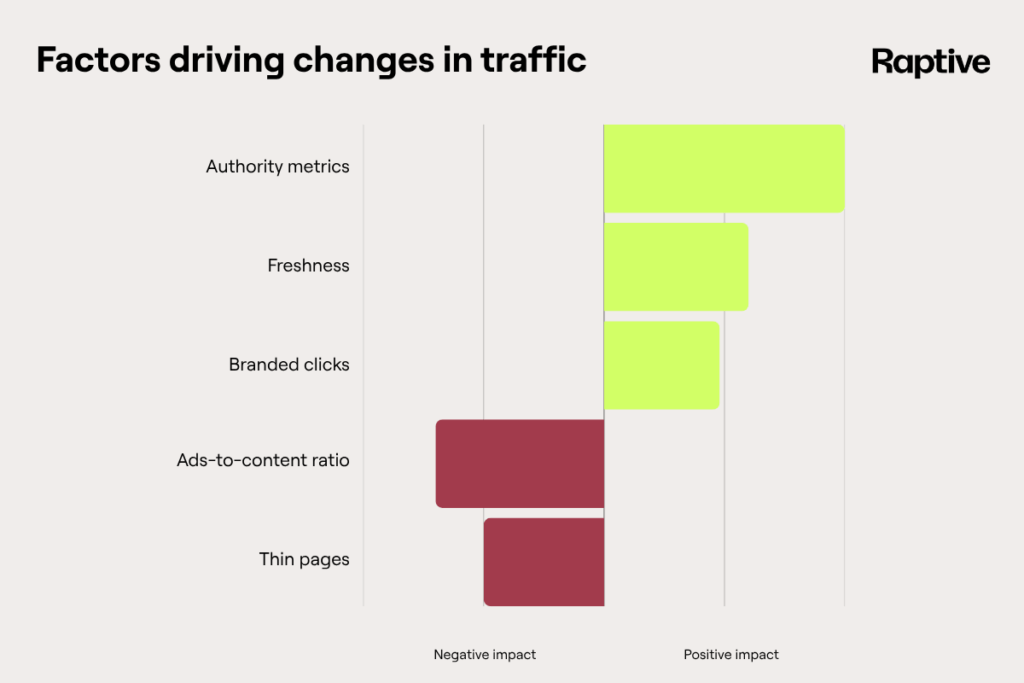
- Authority was protective. Sites with a high Domain Authority (DA) of 40 or more, and those with strong branded search impressions and clicks, fared best in this update.
- Balanced ad density performed best. In our analysis, sites with an average ads-to-content ratio showed the most stable performance, while sites with an ads-to-content ratio above 25% were more likely to see declines. This aligns with Raptive’s guidance on ad density to ensure a positive reader experience.
- Fresh content helped. Sites with fresher and more robust content, especially food sites, tended to benefit more from the update.
- Thin pages lost ground. Posts under 500 words consistently underperformed, but word count itself is not a ranking factor. These posts likely lost traffic because they are not comprehensive or helpful to readers, not solely because of their length.
What to do next
Even in a changing search environment, these results suggest our network continues to demonstrate strong resilience and the ability to adapt and stay competitive through future updates.
If you’ve been following our team’s recommendations, your strategy should stay largely the same. Continue to focus on content quality, clarity, and building trust with your readers, as well as:
- Reduce the number of ads if they overwhelm your content. We recommend an ad density of 20% on desktop and 24% on mobile for most Raptive creators. You can adjust your settings in your dashboard.
- Update content regularly. Fresh, in-depth content (especially in food and fast-moving niches) still wins. For evergreen content, we recommend 10 or more updates per month.
- Review your low-performing content. Audit your library regularly to combine, update, or remove thin posts or pages that don’t add value.
- Build authority. Show off your expertise by boosting your E-E-A-T signals, highlighting your credentials, building out a great About page, encouraging branded search traffic, and earning high-quality mentions from reader comments and relevant sites you trust.
- Focus on Google Discover. Timely sports articles are attractive for Google Discover, a growing traffic source that is less affected by the challenges shared above. But it’s not just for sports or news sites. All verticals can diversify away from traditional search volatility by prioritizing these Google Discover tactics.
Our foundational SEO advice still stands; by putting your audience first and sharing original, helpful content, you’re best positioned to stay ahead of whatever updates come next.
 `
`
 `
`
 `
`