What Google’s March 2026 core update revealed about AI Overviews

Google’s March 2026 Core Update made one thing clear: AI Overviews are becoming a bigger part of search, changing where content appears and how clicks are earned.
During the March 27–April 8, 2026 rollout, AI Overviews became more common across tracked food impressions, increasing from less than 20% to 26–31%. Non-food results followed a similar pattern, with AIO coverage rising from 24% to 32% of tracked impressions.
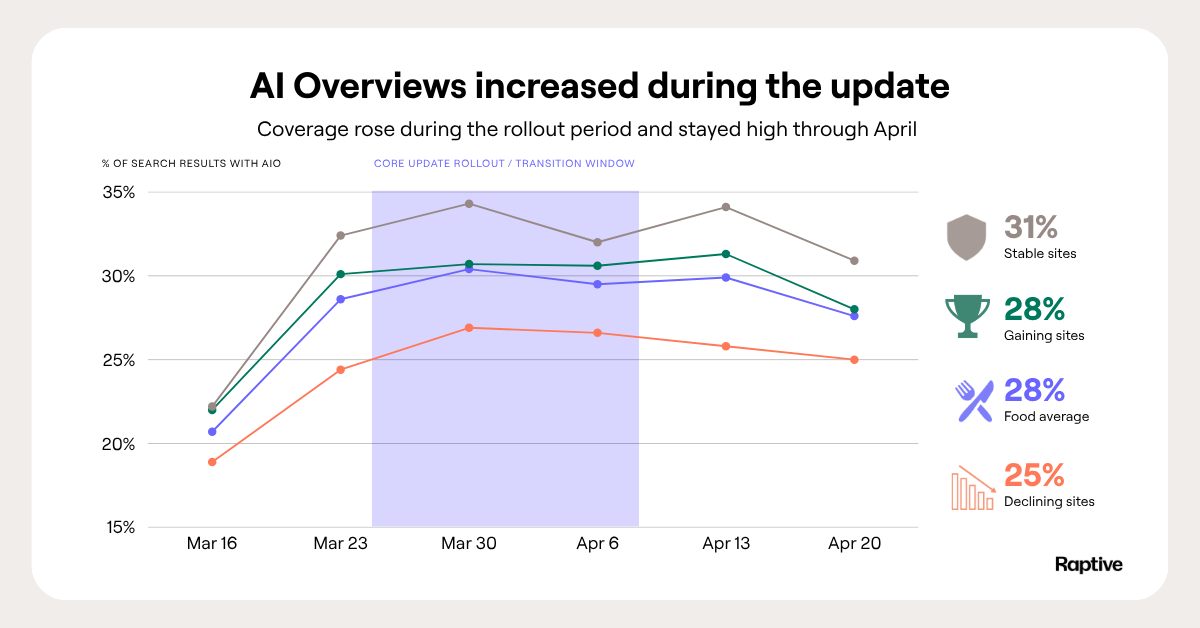
But search visibility doesn’t always mean more site traffic. When Google shows more complete answers directly in search results, some people may get what they need without clicking through to a creator’s site.
This update reinforced what we’ve seen in other recent updates: AI Overviews may be changing how people discover and click on content, but the sites that performed best were still stronger across key quality signals—content depth, freshness, authority, and reader experience.
AI Overviews changed traffic patterns in food search results
As AI Overviews became more common in food search results during the March update, fewer searchers clicked through to creator and publisher sites. Our data shows that search results with AI Overviews had click-through rates 30%–50% lower than those without them.
But AI Overviews don’t fully explain why some sites lost traffic while others gained. Sites that lost traffic didn’t have more AI Overview coverage than sites that gained traffic. That suggests AI Overviews likely reduced clicks across food search overall, but they weren’t the main factor separating stronger-performing sites from weaker-performing ones.
AI Overviews may make it harder to earn search traffic, but citations still give readers a path back to your site. When your content is cited in an AI Overview, you have a better chance of earning some of the clicks that might otherwise be lost when Google answers the query directly in search results.
Google also appears to be improving how links show up in AI-powered search experiences. In May 2026, Google announced updates to AI Mode and AI Overviews to help people find relevant websites, original content, and useful sources. These updates include more inline links, link previews, suggestions for deeper exploration, and added context around firsthand sources.
That doesn’t erase the traffic challenges AI Overviews have created, but it reinforces why citation visibility matters. The more clearly Google surfaces links to helpful, original content, the more opportunities creators have to be discovered directly from AI-powered search results.
What stronger performing sites have in common
The sites that performed best during the update tended to show stronger quality signals that help readers and search engines trust a site, including clear authority, complete and helpful content, fresh information, visible review proof, and a cleaner reader experience.
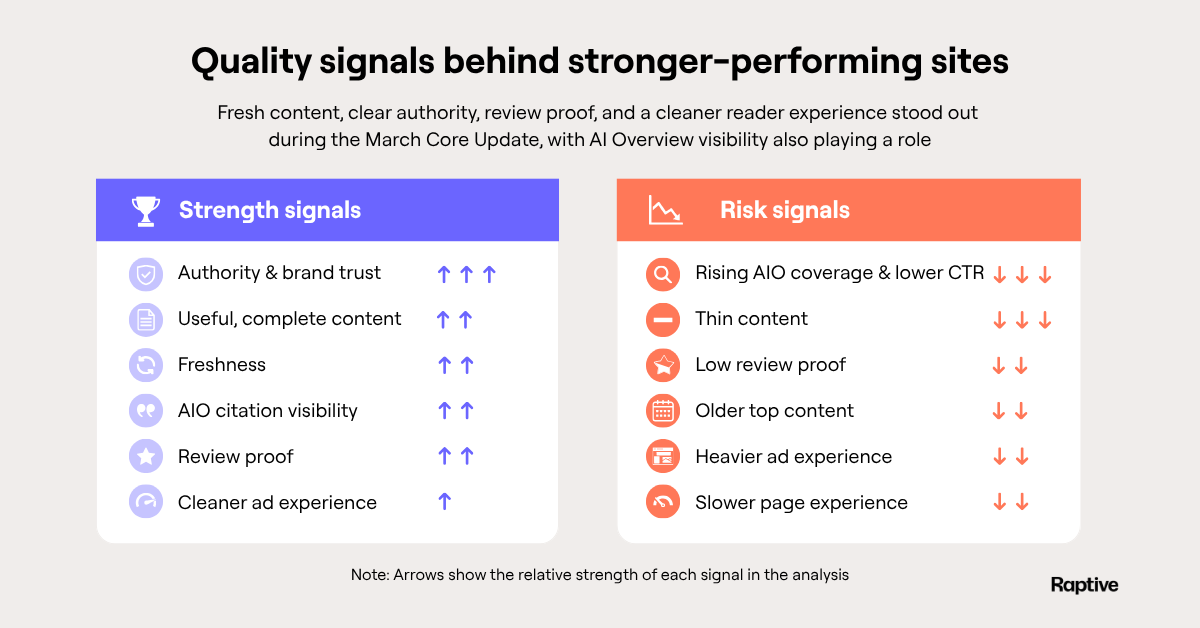
The opposite was also true. Sites that lost visibility or clicks were more likely to show signs of quality pressure, including higher AI Overview coverage with lower click-through rates, thin content, lower review proof, older top content, heavier ad experiences, and slower page experience.
These signals don’t work in isolation. Strong content can still be held back by a poor reader experience. Strong authority can lose value if important content becomes stale. And as AI Overviews take up more space in search results, sites may need stronger trust and quality signals to keep earning clicks.
The strongest-performing sites weren’t winning because of one isolated factor. They tended to have multiple signals working together across content, trust, freshness, and reader experience.
Authority and trust signals stood out
The sites that performed better during this update were more likely to have strong brand clicks, positive reader reviews, and higher third-party authority scores.
These signals were also more common on sites with greater visibility in AI Overviews.
On average, stronger-performing sites had:
- More than 8,000 branded clicks over 12 months
- An Authority Score above 47
- For food sites, 40 or more reader reviews with an average rating of 4.8 out of 5 or higher
For food creators, review proof appeared to be a meaningful trust signal. Higher-ranking results had more reviews and were more likely to display review stars, while average star ratings stayed nearly the same.
That suggests the number of positive reviews and whether those reviews are visible may matter more than small differences in ratings.
| Post-update ranking group | Avg. reviews when 5-star | Avg. star rating | % of results with review stars |
| Strong ranks 1-3 | 605 | 4.85 | 72.6% |
| Mid ranks 4-7 | 269 | 4.82 | 37.9% |
| Weaker ranks 8-10 | 178 | 4.81 | 34.9% |
Stronger-ranking results had about 3.4x as many reviews as weaker-ranking results, with only a 0.04-star rating advantage. That suggests strong star ratings may help you compete on page 1, but review volume may be what helps your content stand out among other highly rated results.
Content depth and freshness mattered
Across thousands of sites in our network, we looked at word count and the percentage of thin pages as indicators of content depth.
Sites with more thin pages were more likely to lose visibility or clicks during this update. Sites where more than 13% of pages had fewer than 500 words were more likely to see losses, while sites with less than 5% thin pages and an average word count of about 1,400 words or more were more likely to perform better.
Word count alone doesn’t determine quality. A longer page isn’t automatically more helpful, and a shorter page isn’t automatically thin if it fully answers the reader’s question. But at the site level, these patterns can help show whether creators are giving readers enough original, useful information across their content.
The stronger pattern wasn’t simply that longer content performed better. Sites were better positioned when they had fewer thin pages, more complete content, and fresher information that helped readers make decisions, follow a recipe, or understand the topic more clearly.
Page experience and ad density played a role
A strong page experience continued to matter during this update. Sites that lost visibility or clicks were more likely to have slower load times or higher ad density, especially on pages with less content.
Ad density can feel more noticeable on shorter or thinner pages because there’s less content to balance the experience. Even a standard ad setup can feel heavier when a page is crowded, thin, or hard to navigate.
Pages with higher ad-to-content ratios were more likely to underperform, especially when the layout felt crowded or difficult to read. To help keep the reader experience balanced, we recommend staying within 20% ad density on desktop and 24% on mobile.
Clean layouts, fast load times, and a balanced ad-to-content ratio make it easier for readers to get what they came for while still supporting your revenue.
What sites cited by AI Overviews had in common
The sites cited by AI Overviews didn’t always match those that saw the most traffic during the core update. AI Overview visibility appeared to rely more heavily on authority, audience reach, and the strength of a site’s overall content library.
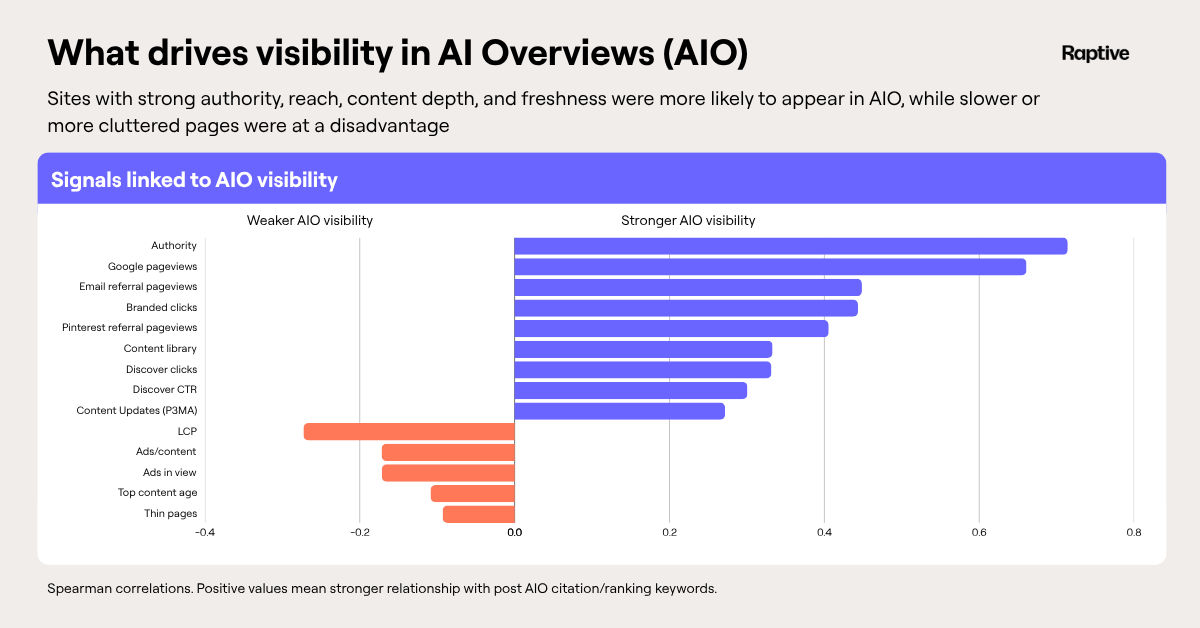
Food sites with stronger AI Overview visibility tended to have larger existing audiences, more recently updated content, and faster pages. This suggests Google may be favoring established sites with strong freshness and performance signals when choosing sources for AI Overviews.
We also saw patterns that appeared to work against AI Overview visibility, including slower load times, higher ad-to-content ratios, more ads in view, older top content, and a higher percentage of thin pages.
AI Overview visibility isn’t just about optimizing one page for one query. It’s about strengthening the site-level signals that help Google understand your content as trusted, useful, and relevant in your niche.
How to strengthen your site for AI-powered search
AI Overviews are changing how clicks are earned from search, but the core principles of strong SEO still matter. Focus on the areas that help your site stay useful, trusted, and easy to navigate: helpful content, clear expertise, audience trust, and a strong reader experience.
Refresh your most important content
Audit older, high-value pages and build a refresh calendar. Start with pages you haven’t updated in the last 20 months, especially those that drive traffic or revenue, support your main content topics, or anchor important categories on your site.
When you update a page, focus on making it more helpful, complete, and useful for readers. Add the details, context, and clarity someone would need to confidently use the information, follow the recipe, or take the next step.
If you use the SEO Workbook, the Pages to Update tab can help you quickly find pages that are ready for a refresh.
Look for ways to:
- Add missing context
- Answer related questions
- Update photos or examples
- Clarify instructions
- Add helpful internal links
Review low-performing content
Decide which weaker pages to improve, combine, or remove so your strongest content is easier for readers and search engines to find.
Thin, outdated, or unhelpful pages can make it harder for your best content to stand out. Cleaning them up can improve the overall reader experience and help search engines better understand which pages are most useful, current, and worth surfacing.
Focus on pages that:
- Get little or no traffic
- Haven’t been updated in a long time
- Overlap heavily with stronger pages
- No longer support your current expertise, niche, or content strategy
- Don’t give readers enough useful information to satisfy the search query
Build brand authority and own your audience
Search engines are placing more weight on signals that show real authority, audience trust, and reader demand. That makes it even more important to build a brand people recognize, trust, and return to directly.
Focus on:
- Growing your email list
- Giving readers a reason to come back directly with high-quality content
- Building brand recognition that leads people to search for you by name
- Strengthening trust signals, like reviews, citations, and clear expertise
For food creators, review volume may be especially worth watching. High ratings are important, but our analysis suggests visible review proof can help stronger results stand out.
To encourage more positive reviews, make the ask simple and timely: remind readers near the recipe card or after helpful recipe tips to leave a rating if they tried and loved the recipe.
Improve the reader experience
Helpful content performs better when the page experience makes it easy for readers to stay, explore, and take action. Fast load times, clear layouts, and a balanced ad experience help readers find what they need and get more value from your content.
Focus on keeping your site:
- Fast, so readers can get to your content quickly
- Easy to navigate, especially on mobile
- Clear and uncluttered, with minimal distractions
- Balanced in ad density, especially on shorter posts
This update reinforces that search visibility alone isn’t enough. Creators and publishers also need to give readers a clear reason to click, stay, subscribe, return, and search for their site by name.
You can’t control how Google or AI Overviews change search results, but you can control the strength of your site. Search will keep evolving, but the goal stays the same: build a site readers trust, remember, and choose.
That starts with helpful content, clear expertise, easy-to-use pages, and an audience that has a reason to come back. Strengthen those areas, and you’ll build a stronger foundation for search, AI Overviews, and whatever comes next.
See other Google update recaps and analyses:
 `
`
 `
`
 `
`