October’s food traffic slowdown: What changed in search and where creators can focus


Raptive’s latest analysis looks at expanded AI Overviews, October’s missed seasonal lift, and where food creators can focus this holiday season as a result.
Fall usually brings a seasonal traffic lift for food creators as readers plan holiday menus, search for recipes, and return to familiar favorites.
This October, that seasonal increase in food search traffic stalled around October 6, and search pageviews finished the month down 19% compared with last year.
Our analysis of more than 2 million keyword data points suggests that changes in Google’s AI Overviews around the same time—on October 5—contributed to the slowdown. AI Overviews appeared across more food searches and moved higher in the results, potentially giving readers fewer reasons and opportunities to click through to a creator’s site.
Other traffic sources helped close some of the gap; non-search pageviews grew about 12% year over year, limiting the decline in total food pageviews to 8%.
Here’s a closer look at what’s changing in food search and where creators can focus their efforts this holiday season: helping readers successfully make recipes, reaching readers through social channels, and improving existing posts.
Food search traffic softened while non-search traffic grew
In Raptive’s reporting for food sites, October search pageviews fell about 19% compared with last year, following a 13% year-over-year decline in September. These figures include Google and other search engines.
Our SEO team’s food-search analysis also found that Google Search impressions fell 18% year over year in October, which means that publishers’ content appeared less often in search results.
Search accounted for roughly two-thirds of these food sites’ pageviews last October, so declines in that channel have a substantial effect on overall traffic.
Other channels helped close some of the gap. For food sites, the same October reporting showed year-over-year growth across several channels:
- Social pageviews grew 25%
- Direct pageviews grew about 5%
- Other non-search pageviews grew about 8%
Together, non-search pageviews increased about 12%, helping limit the estimated decline in total pageviews to 8%.
These results don’t tell us whether individual readers moved from search to social. They do show growth beyond search, reinforcing the value of giving readers several ways to find and return to your content.
AI Overviews appear across more food searches
From September to October, the number of tracked food keywords with an AI Overview increased by 50%. Publisher impressions associated with those keywords grew by much less, which suggests that some of the expansion was into lower-volume searches.
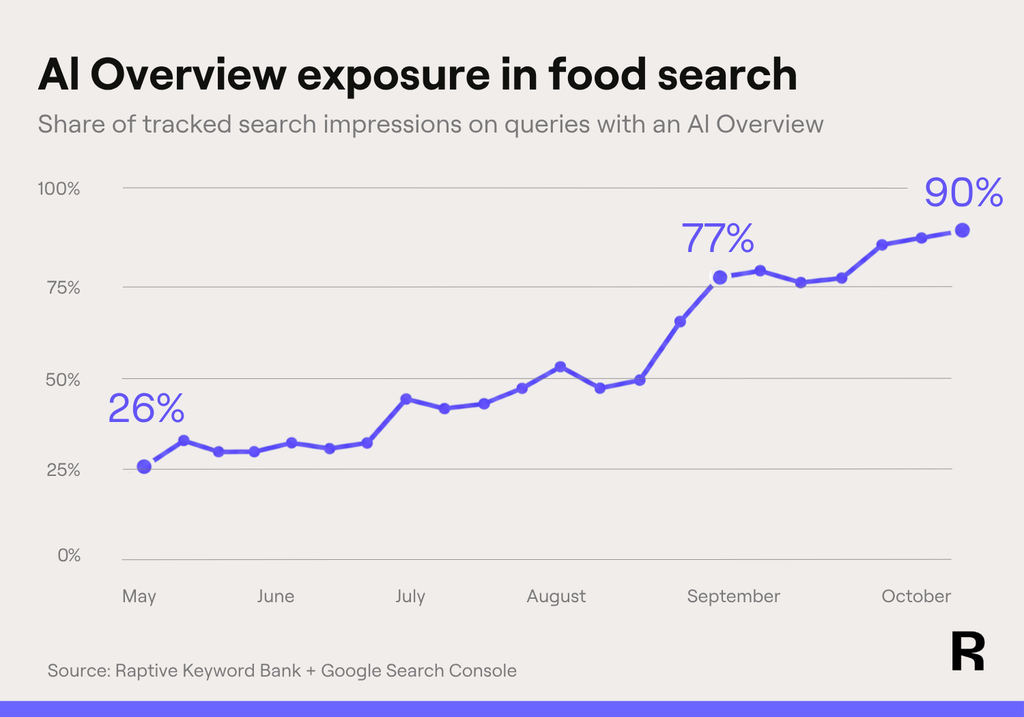
AI Overviews are spreading across more food searches, including less frequently searched terms. Their potential effect on traffic also depends on where they appear on the page, and whether readers still need to visit a creator’s site.
Alongside that expansion, AI Overviews have become more prominent, their answers have grown longer, and references to original recipe sources have become more common.
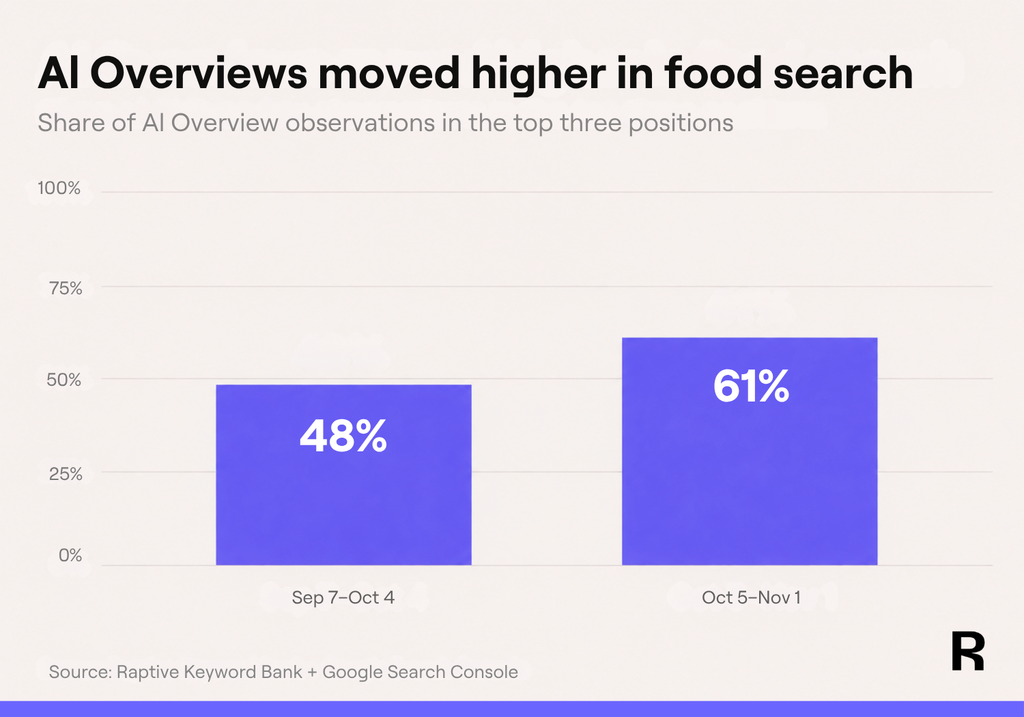
- AI Overviews are moving higher in search results. Across the tracked keyword set, AI Overviews appeared in the top three positions 27% more often during October 5–November 1 than during September 7–October 4. Higher placement can push traditional listings farther down the page, potentially reducing opportunities for clicks even when a creator’s organic rankings stay the same.
- Answers are getting longer. The average amount of captured answer text increased by approximately 20% between September and October. More detailed answers could give readers the information they need directly on Google, reducing the need to click through to a website for the recipe or answer.
- Recipe referrals are becoming more common. Phrases such as “See this recipe at [website]” appeared in 65% of recipe-related AI Overviews in October, up from 45% in September and 27% in August. These references could help readers find original recipe sources and create opportunities for referral traffic. The impact on clicks remains to be seen.
We believe AI Overviews are contributing to declines in food search traffic by answering some questions without requiring a site visit. However, our data does not isolate how much of the decline they caused.
Why average click-through rate can rise while traffic falls
A higher average click-through rate doesn’t always mean more search traffic. If searches that rarely lead to clicks generate fewer impressions, the overall average can rise, even as those searches send fewer visits to your site.
At the same time, AI Overviews appearing higher on the page can reduce opportunities for clicks on searches that typically send more traffic. Looking at clicks and impressions alongside average click-through rate gives you a clearer picture of how your content is performing.
The rest of the search results page matters, too
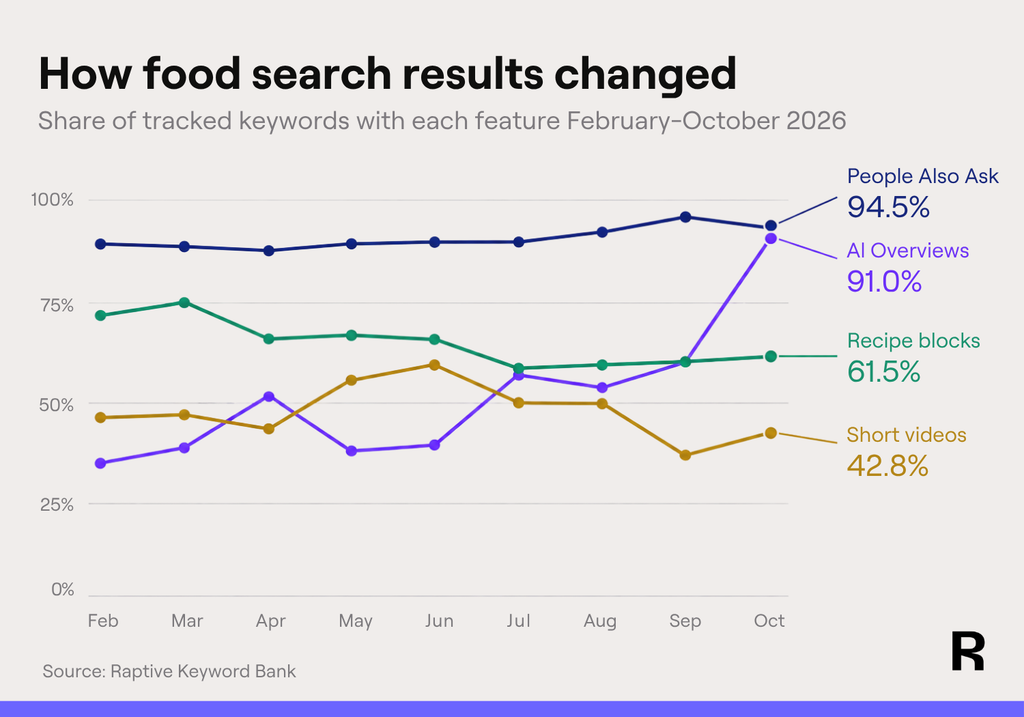
AI Overviews appear alongside recipe cards, videos, images, and People Also Ask results. In the food panel’s latest October reading, recipe blocks appeared in results for about 55% of tracked impressions, short-video blocks for 39%, and People Also Ask for 91%. Multiple features can appear on the same results page, so these percentages do not add up to 100%.
Recipe and short-video blocks appeared less often than in early August, even as AI Overview coverage expanded. These shifts reinforce the importance of looking at the full search results page when evaluating a traffic change.
When reviewing a traffic change, consider your page’s rankings, the surrounding search features, and whether readers need to visit your site for more detail. The presence of an AI Overview is one part of that picture.
Where food creators can focus now
These findings point to three priorities for the rest of the holiday season.
1. Create recipes readers want help making
For food creators, some recipes give readers more reasons to seek detailed guidance on technique, timing, texture, or substitutions. Someone baking linzer cookies, for example, may need more step-by-step help—and expertise from a trusted creator—than someone roasting pumpkin seeds.
Our analysis suggests that AI Overview placement varies across recipe types. In a sample of 656 recipe queries, AIOs appeared at the top of the search results for about 65% of simpler-preparation queries, compared with 28% of more technique-intensive queries. For the latter group, AIOs most often appeared at position four or lower.
These snapshots are consistent with Google adapting results to different search needs, though they do not establish why Google chose those placements. Recipe difficulty and search-question complexity are also different things. Someone troubleshooting even a simple recipe may need a detailed explanation, and Google explicitly describes AIOs as useful for complicated questions. More demanding recipes may give readers more reasons to seek hands-on guidance, but complexity alone does not guarantee that AI answers will be less prominent.
For your content, focus on guidance that helps readers successfully make the recipe.
Consider including the following:
- Original testing and practical details from making the recipe yourself.
- Clear process photos and visual cues for doneness.
- Useful substitutions and explanations of how they affect the result.
- Troubleshooting for common mistakes.
2. Keep investing in social distribution
October’s social growth shows that food creators are continuing to attract visits outside search.
In a separate analysis of 1,122 eligible food sites, we compared August–October 2026 with the same period in 2025. Sites with growing Facebook and Pinterest traffic tended to be more resilient in Google Search, with smaller declines in search pageviews than sites whose traffic from those platforms fell.
This relationship does not necessarily show that posting on social improves Google rankings; differences in content, audience loyalty, and resources may contribute to both outcomes.
Build distribution into your holiday content schedule.
- Pair recipes with Pins, process videos, or Facebook posts that suit your audience.
- Share favorite seasonal recipes and cooking content as readers begin looking for them.
- Track which platforms and posts send visits to your site.
- Give those visitors a compelling reason to join your email list, such as a curated recipe collection or a helpful guide.
3. Keep publishing and making purposeful updates
Continue creating well-tested recipes and improving the ones readers already rely on. Based on activity among the fastest-growing food sites in the Raptive network in Q4 2025 and August to October 2026, we recommend targeting at least five new posts and 12–15 content updates per month in Q4 2026. Prioritize quality, relevance, and meaningful improvements as you work toward this cadence.
Give each update a clear purpose. Prioritize seasonal recipes that need better photos, instructions that leave readers with questions, or pages that still appear in search but attract fewer visits. Raptive’s SEO Workbook can help eligible creators find those opportunities.
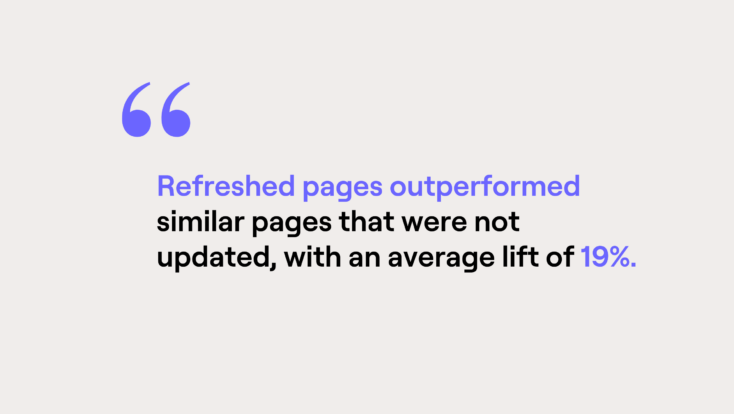
Our broader analysis of content refreshes also found stronger performance associated with meaningful improvements. In a matched comparison of more than 5,500 refreshed and unrefreshed page pairs, refreshed pages averaged 28% growth in Google pageviews, compared with 9% for unrefreshed pages.
These historical findings support investing in improvements that address readers’ needs, but they do not guarantee similar gains in today’s search environment.
Review search and social traffic together to understand which new recipes and updates are attracting readers. Use those findings to decide what to improve, share again, or test next.
What we’re watching in November and December for food sites
The year-over-year decline in search traffic for food sites could deepen through the holidays. AI Overviews could appear on results pages associated with nearly all food-search impressions in our tracked panel. Readers could also click through less often on results pages that already include an AI Overview.
An increase in AI Overview coverage does not translate directly into an equivalent loss of clicks. Search demand, rankings, other search features, and the extent to which results meet readers’ needs also affect traffic.
We’ll continue tracking search, AI Overviews, and other traffic sources as the holiday season unfolds.
 `
 `
 `