We analyzed 103,000 content refreshes. Here’s what was most associated with Google traffic growth

Content refreshes can support Google traffic growth, but not all updates appear to have the same impact.
The analysis comes at a time of renewed industry interest in content refreshes. In 2024, a large set of internal Google Search API documents became public, sparking discussion about how Google may evaluate refreshed content and whether meaningful updates matter more than surface-level freshness signals.
To better understand what this looks like across the Raptive network, our SEO team analyzed 103,000 refreshed pages over a 16-month period. The analysis compared Google pageviews and average search rank in the 60 days before and after each refresh. We also compared more than 5,500 refreshed URLs with similar URLs that were not updated during the same period.
The clearest pattern aligned with Raptive’s refresh guidance and the broader direction of search: content refreshes performed best when they made meaningful improvements to the page, not just small edits.
That matters even more as search and AI-powered discovery continue to evolve. Content needs to clearly demonstrate its value to readers and search systems.
Key takeaways
- Refreshed pages outperformed similar pages that were not updated in Raptive’s matched-control analysis, with an average percentage-point lift of 19%
- In the pre/post analysis, meaningful refreshes, defined as more than a 10% change in word count, drove about 9% more Google pageview growth than lighter refreshes
- Updates to visible page elements, including titles, images, and paragraph structure, were associated with stronger average performance
- Refreshes do not guarantee traffic growth. Search demand, seasonality, competition, and changes in Google results can all influence performance
How we measured performance
To avoid relying on one view of the data, we measured refresh performance in two ways. First, we compared Google pageviews and average rank in the 60 days before and after each refresh across 103,000 pages and 38 verticals. We included URLs with enough measurement history, including at least 28 observed days in the pre-refresh period.
Second, we ran a matched-control analysis across 5,500 pairs of refreshed and non-refreshed URLs. Each refreshed URL was compared with a similar URL that was not refreshed during the same time window. Control URLs were selected based on factors such as site, vertical, content age, baseline traffic, and baseline rank.
The pre/post analysis helped us understand what happened after refreshes were made. The matched-control analysis helped separate refresh impact from normal rank movement, seasonality, and broader site or category trends.
Refreshed pages outperformed similar pages that were not updated
The matched-control analysis showed the clearest evidence that refreshes were associated with incremental gains.
In the matched-control analysis of 5,500 refreshed and non-refreshed URL pairs, refreshed URLs averaged 28% Google pageview growth. Similar pages that were not refreshed averaged 9% growth. That equals a 19-point lift compared with similar pages that were not updated.
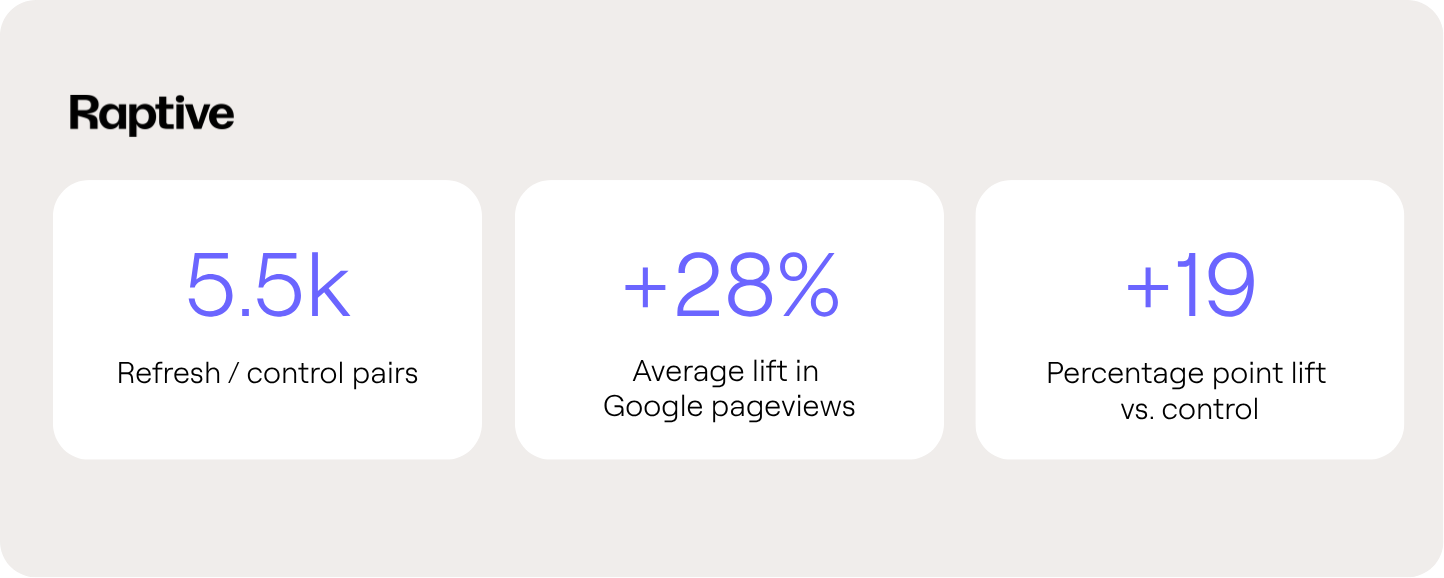
That doesn’t mean every refresh will drive traffic growth, but it gives us a stronger signal that thoughtful updates can help pages perform better than leaving similar content untouched.
We also ran a pre- and post-refresh analysis on 103,000 pages across 38 verticals. Across all refreshes, pages averaged a 4.50% increase in Google pageviews and a –0.25 average rank movement, where a negative number indicates improvement.
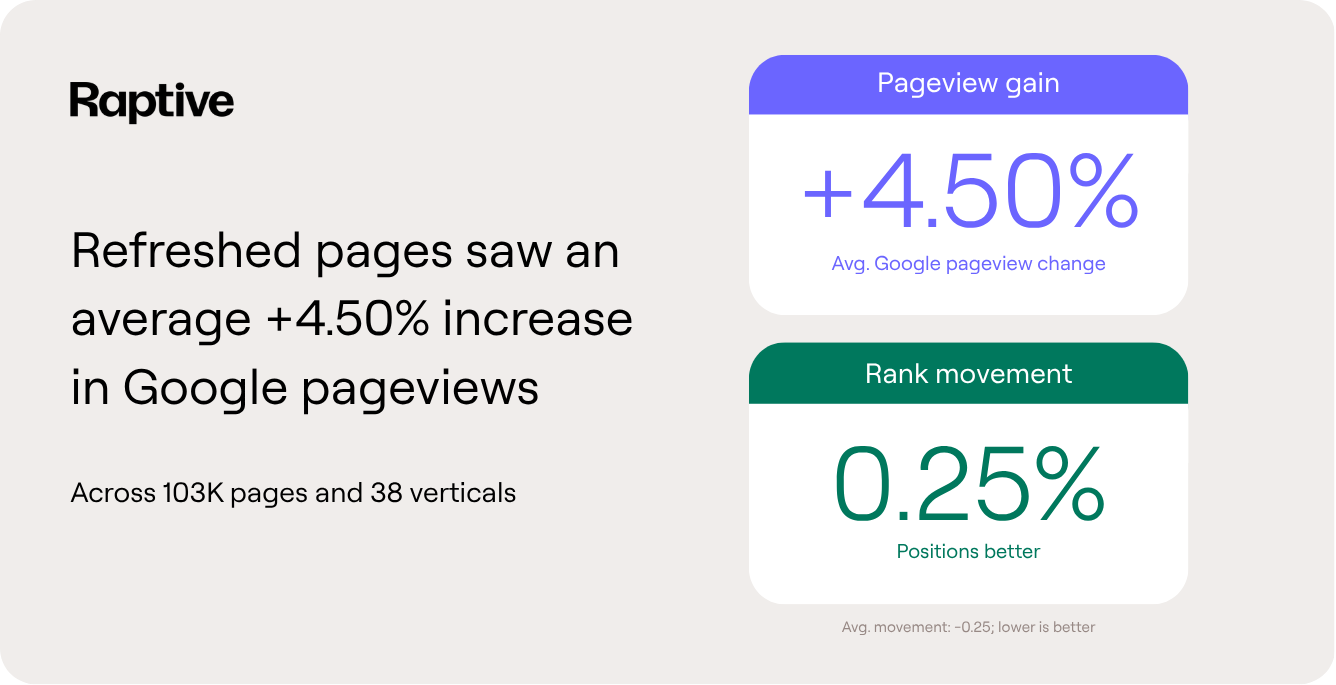
Meaningful refreshes were associated with stronger gains
The depth of the update mattered.
To measure refresh depth at scale, we used the change in word count as a proxy. Refreshes with a change in word count of 10% or less were grouped as lighter refreshes for this analysis.
Refreshes with more than a 10% change were grouped as meaningful refreshes, major rewrites, or extreme rewrites.
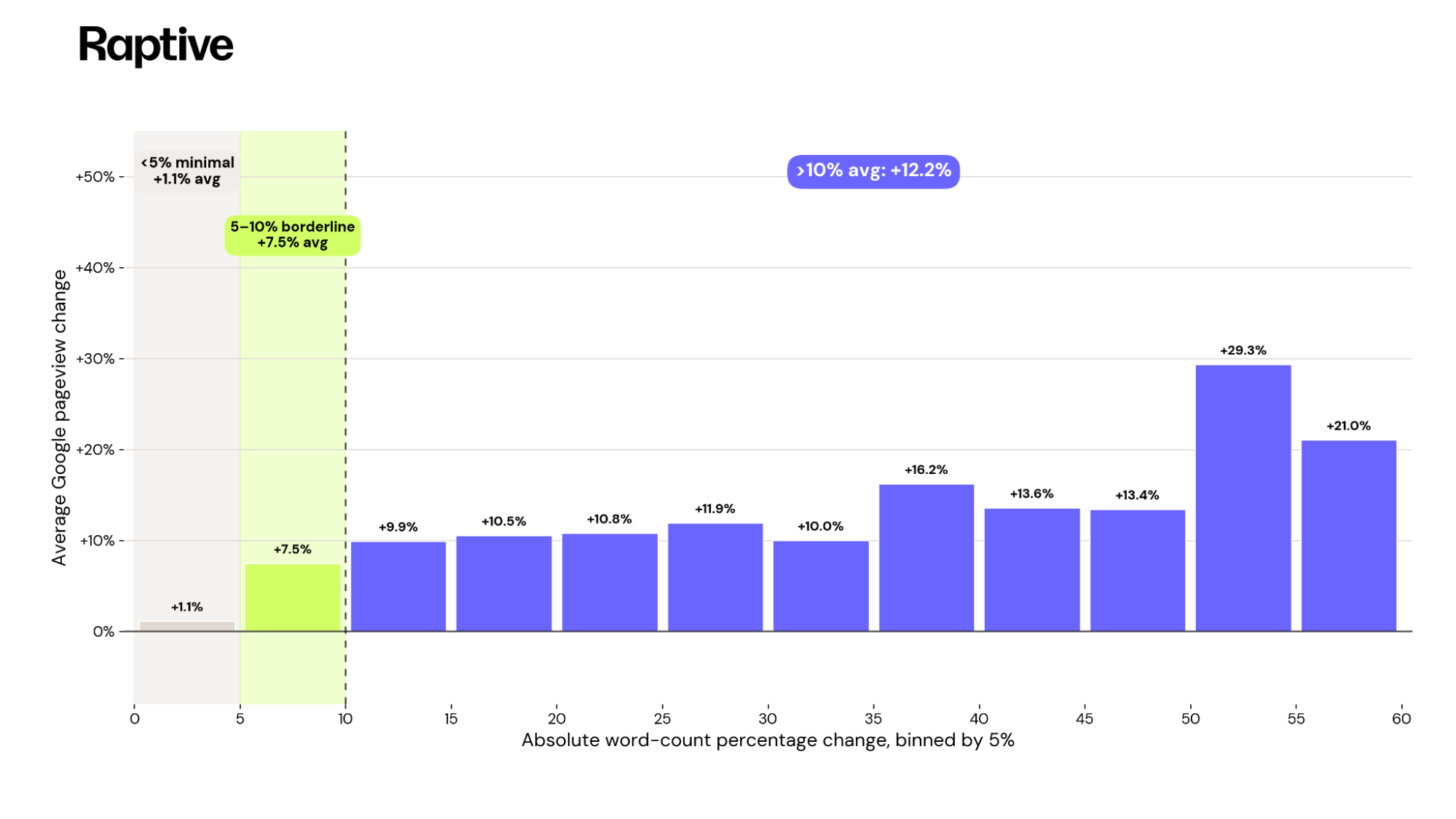
That doesn’t mean every post needs a large-scale refresh, but it does suggest that more substantial updates tend to outperform smaller tweaks.
In the pre/post analysis, we saw the clearest performance increase once refreshes changed more than 10% of the page’s word count.
- Lighter refreshes, with 0–10% word count change, averaged 2% Google pageview growth
- Meaningful refreshes, with 11–30% word count change, averaged 11% growth
- Major rewrites, with 31–100% word count change, averaged 11% growth
- Extreme rewrites, with more than 100% word count change, averaged 44% growth
The larger gains from extreme rewrites are worth noting, but they’re not a reason to rewrite every post from scratch. In many cases, needing a major rewrite may signal that the page had room for meaningful improvement.
High-impact page elements were associated with stronger growth
Meaningful refreshes aren’t just about how much you change. They’re about improving the parts of the page that most affect usefulness, clarity, and performance.
In the pre/post analysis, pages with image changes saw the strongest average gain, with a 14% increase in Google pageviews across 28,000 pages. Pages with title changes averaged an 11% increase, and pages with paragraph count changes also averaged an 11% increase.
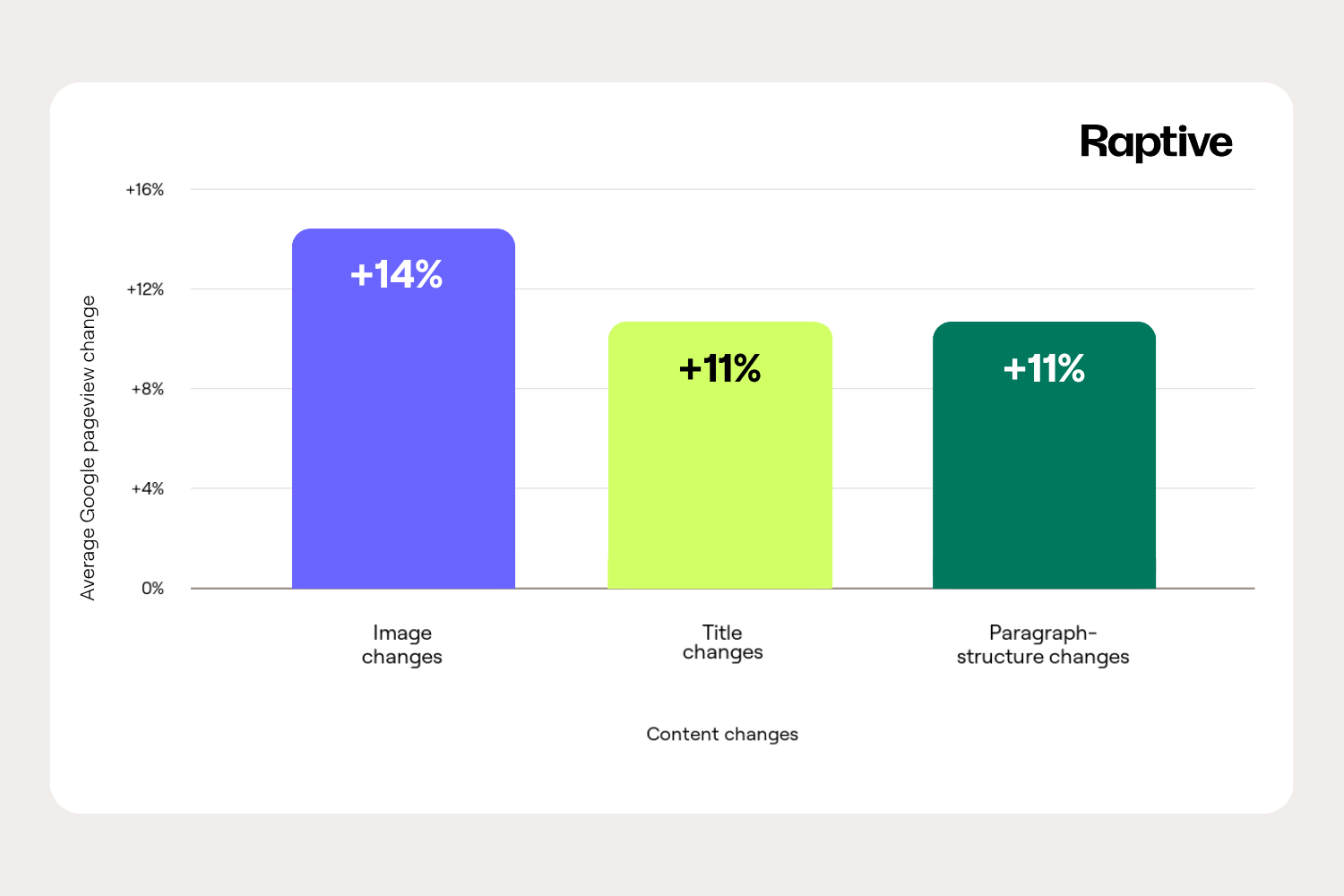
These categories may overlap, since a single refresh can include multiple types of updates. That means the findings show association, not proof that any single element caused the gain.
Still, the pattern is helpful. The updates associated with stronger performance were also updates that can make a page more helpful for readers. A clearer title helps the content better match the query, stronger images make the page more useful, and improved paragraph structure helps readers find the answer faster.
As you refresh content, look beyond small edits and focus on the full reader experience.
Refreshes don’t guarantee traffic growth
Meaningful updates can support Google traffic growth, but results still depend on topic, vertical, search demand, seasonality, competition, and changes in search results.
That’s why the strongest refresh opportunities aren’t always the oldest posts. Better candidates are often pages where people are still searching for the topic, but the content could better answer their questions with helpful, complete, or up-to-date information.
The vertical-level results show why that context matters. Food pages saw the clearest gains in this analysis, averaging 10% Google pageview growth across 64,000 refreshed pages. One possible explanation is that food content often benefits from practical updates readers can use right away, like stronger images, clearer instructions, updated tips, better structure, and more complete answers.
Pets saw average Google pageview declines, even as rankings improved modestly. Pets pages averaged a 10% decline with a –2.90 average rank movement.
A ranking improvement is a positive signal, but it doesn’t guarantee more traffic. A page still needs enough search demand, available clicks, and content that gives readers a reason to choose it.
How to prioritize content refreshes
A strong refresh starts with the right opportunity, not the oldest publish date. A 10-year-old post with little search demand or audience value may not deserve your time.
A three-year-old post that still appears in Google Search and ranks near the bottom of page one or the top of page two may be a stronger candidate, especially if the content could do more to answer what readers are looking for.
Start with posts most likely to benefit from meaningful improvement.
Look for content that:
- Used to bring in steady Google traffic, but has declined
- Ranks near the bottom of page one or the top of page two
- Still aligns with your audience, but no longer feels current
- Has performed well during past seasonal peaks
- Needs updates because the search results have changed
- Includes outdated facts, weak examples, old photos, or thin sections
Raptive creators can use the SEO Workbook in their dashboards to identify these high-value opportunities and prioritize posts with clear search demand, existing visibility, and room to better serve the reader.
Focus on usefulness, not freshness signals
The strongest refreshes aren’t the ones that make a post look newer. They’re the ones that make the content more useful to readers.
Raptive’s analysis points to a more strategic approach to content updates. Choose pages with real search opportunities and clear room for improvement, then focus on changes that make the page clearer, more accurate, and more complete.
Updating a publish date should reflect meaningful improvements to the page. The goal isn’t to signal freshness, but to create a better experience for your readers.
Search is more complex than it used to be, and traffic growth is rarely tied to one tactic. The creators who will be best positioned are those who use data to choose the right opportunities, invest in meaningful improvements, and keep the reader at the center of every refresh.
 `
`
 `
`
 `
`