Sources still matter: New Raptive research finds 74% want to know where AI gets its information

We’re sharing new data on trust in AI answers and the role of attribution in the consumer journey. AI may be changing how people discover information, but it hasn’t replaced where trust comes from.
Last year, we set out to understand what happens when people believe the content they’re consuming was created by AI—the starting point for our latest deep dive into trust in AI answers. Our research found that when people believed content was AI-generated, it was considered 48% less trustworthy, 57% less authentic, and 60% lower in emotional connection. And that perception didn’t stop with the content. Brands advertising alongside it saw declines in purchase consideration and consumers’ willingness to pay a premium.
We called it “AI stink”: the idea that simply perceiving something as artificial could change how people felt about the content, the creator, and the brands surrounding it.
Since then, a lot has changed. AI is becoming the interface through which people find information in the first place. Instead of clicking through a list of search results, a consumer can ask a question and get an answer. Instead of visiting five websites to research a purchase, plan a trip, or decide what to cook, AI can synthesize that information for them.
So we wanted to understand what happens to trust when the source moves one step further away from the consumer.
If AI delivers the answer, does it still matter who created the information behind it?
What consumers told us about trust in AI answers
AI is becoming a routine part of how consumers research, plan, and make decisions. But new Raptive research shows that convenience hasn’t replaced trust.
In a survey of 3,083 U.S. consumers, people said they want to know where an AI answer comes from—and they don’t automatically believe AI when it conflicts with a publisher, creator, or expert they already trust.
AI may start the interaction. Trusted sources still help consumers decide what to believe.
Key findings
- When AI conflicts with a source consumers already trust, only 19% say they’d believe the AI answer. By comparison, 33% would stick with the established publisher, creator, or expert, and 37% would investigate further.
- 74% say it’s extremely or very important to know the source behind an AI answer or recommendation.
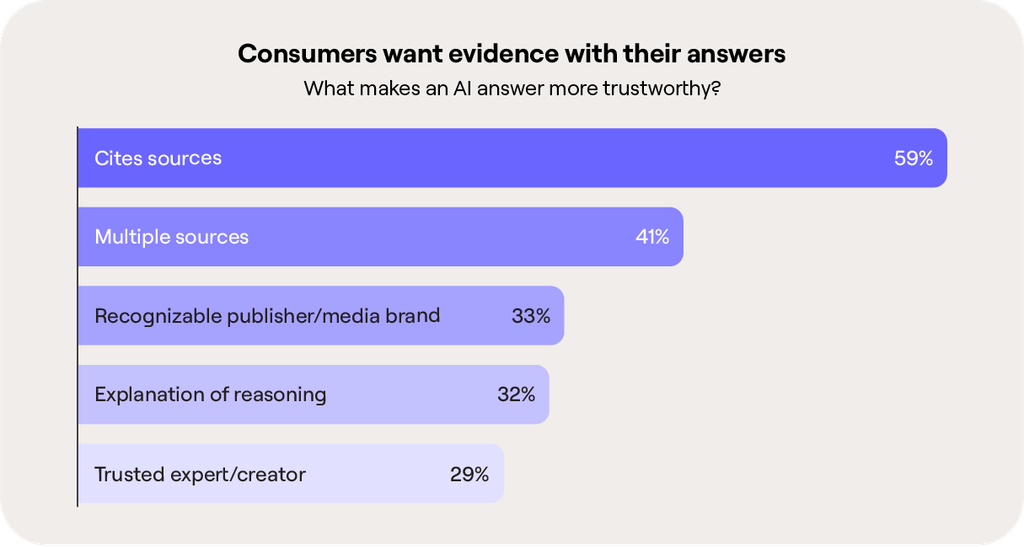
- 59% say citations would make them more likely to trust an AI answer.
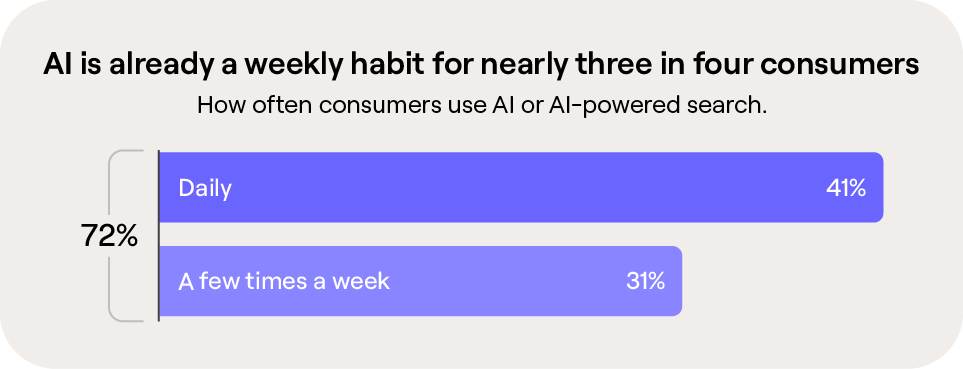
- 72% use AI tools or AI-powered search at least a few times a week, including 41% who use them daily.
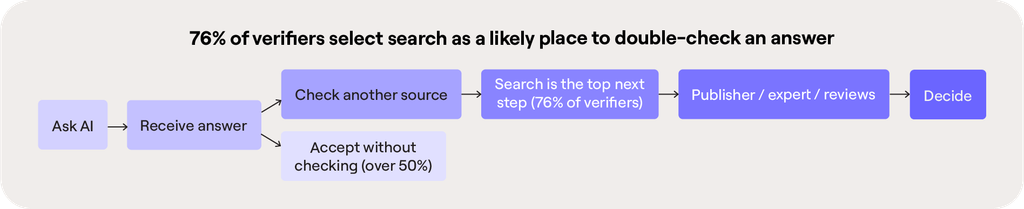
- Among people who double-check an AI answer, 76% turn to Google or another search engine.
- Daily AI users are nearly twice as likely to turn to a creator, expert, or influencer they follow when double-checking an AI answer: 29%, compared with 16% of non-daily users.
The implication for AI platforms, publishers, creators, and brands is clear: showing sources isn’t just a matter of attribution. It gives consumers the context they need to judge whether an answer is worth trusting.

The full report in detail
Picture this: you ask AI where to stay for a weekend in Charleston. It gives you three hotels, tells you which one’s best for kids, where to eat, and what you should do if it rains. All it takes is a few minutes for your trip to take shape.
But you probably didn’t stop to ask who recommended those hotels. Was it a travel publisher who’s been to Charleston a dozen times? A hotel review? Someone who’s actually traveled there with kids?
AI gives us the answer without requiring us to think much about where the answer came from.
In our survey of 3,083 consumers, 72% said they use AI tools or AI-powered search at least a few times a week. We also asked what would make an AI answer feel more trustworthy and people were clear: show them where it came from.
In the survey, 74% said it’s extremely or very important to know the source behind an AI answer or recommendation. 59% said citations would make them more likely to trust it, and more than four in ten wanted multiple sources.
For publishers, marketers, creators, and AI platforms, this is worth paying attention to. People may start with AI, but they still want to know who stands behind the answer.
AI may be the first stop, but it’s not the only one
Sometimes you get a good enough answer from AI and you move on. More than half of respondents said they always or often accept an AI answer without checking another source. Among consumers who double-check AI answers, 76% turn to Google or another search engine. They also visit publisher sites, product-review pages, trusted experts, and online communities. That instinct to seek a trusted human source is even stronger among the people using AI most often. Among daily AI users, 29% say they turn to a creator, expert, or influencer they follow when double-checking an AI answer, compared with 16% of non-daily users.
The people most accustomed to using AI aren’t necessarily treating it as the final word. They’re still looking for familiar voices to help them verify what they see.
That behavior shows us that while AI can collapse a dozen tabs into a single answer, it hasn’t eliminated the sources behind those tabs. When people want more information or another point of view, they still seek out more sources.
For publishers and creators, that means being discoverable still matters. But also increasingly important is being part of the answer before they ever even click.
The content people trust needs to work in both worlds: valuable enough that people seek it directly, clear and authoritative enough to be understood, and attributed when AI is the starting point.
A citation gives people a way to check
There’s a big difference between seeing an answer and understanding why you should believe it. When we asked consumers what would make an AI answer more trustworthy, their top answer was simple: cite the sources behind it.
59% said citations would make them more likely to trust an AI answer. Of those surveyed, 41% said they wanted to see multiple sources. And 33% said knowing that the information came from a publisher, media brand, creator, or expert they recognize would increase their trust.
Visible citation is a consumer-trust issue. In the survey, consumers said they want to know where AI answers come from, and that cited sources made answers more trustworthy.
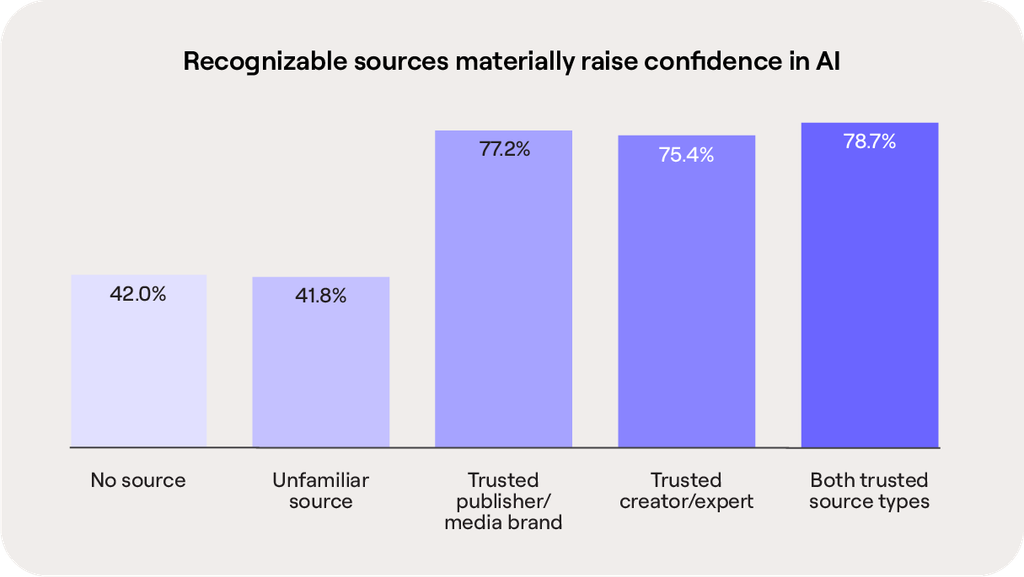
When respondents considered an AI answer with no source shown, fewer than half said they’d trust it completely or somewhat. Trust rose sharply when an AI answer was tied to a trusted website or media brand, a creator or expert consumers recognize, or both. For people who said they trust an answer when it’s consistent with what they already know, visible sources increased trust by 8 to 10 percentage points. The lift was even greater among those who said they trust an AI answer on its own, rising by 32 to 40 percentage points when a recognizable source was shown.
Trust was highest when people saw both a recognizable publisher or media brand and a trusted expert or creator: 78.7% said they’d trust the answer completely or somewhat. Publishers and creators are often framed as competitors, but consumers don’t treat them as interchangeable. Both added confidence, and the strongest trust response came when the two appeared together.
A trusted publisher can bring editorial rigor, reporting, scale, and institutional credibility. A trusted expert can bring specificity, lived experience, and a point of view. Together, they give people more to go on and show that reputation is now part of the answer.
Trust depends on the question
Not every question sends us looking for the same kind of authority.
If you’re following a breaking news story, you might want to know which newsroom reported it. Researching a health question? The credentials of the person giving the advice might matter just as much. And if you’re looking for a recipe, you can trust the creator whose recipes have worked in your kitchen dozens of times.
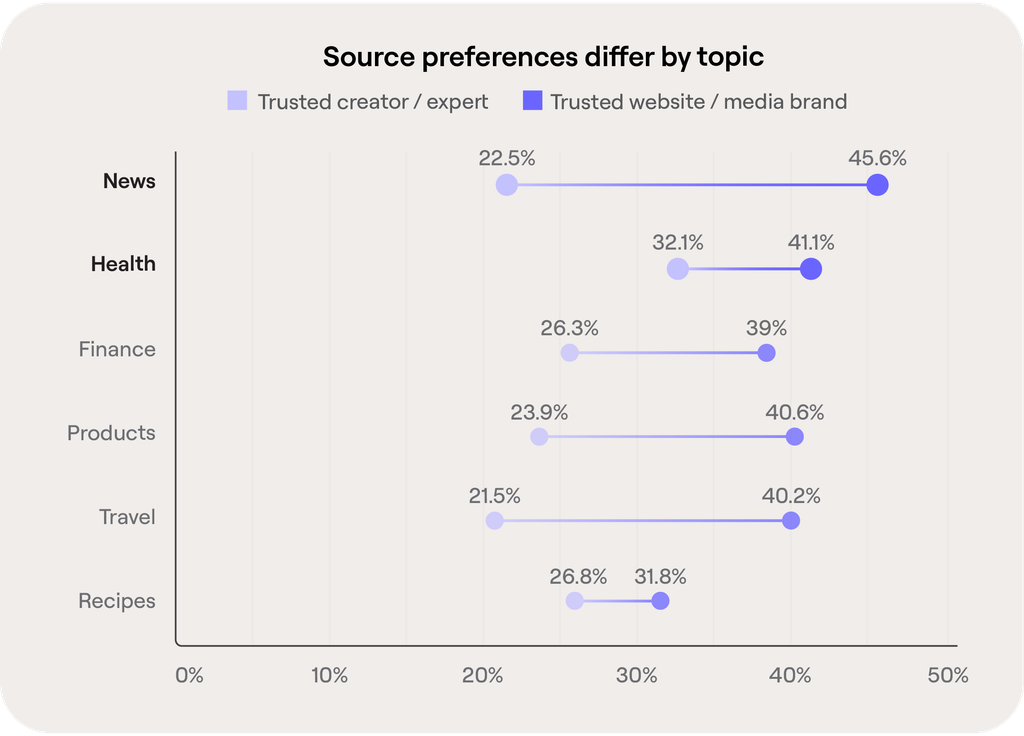
Our research reflects those differences. Across every category we tested—from health and finance to travel, recipes, products, and news—the source’s identity affected how consumers perceived trust. But the kind of source they valued shifted depending on what they were asking.
- For news and current events, respondents showed the strongest preference for a trusted website or media brand.
- For health and wellness, trusted experts and recognized publishers were much closer.
- And across categories like products, travel, recipes, and financial guidance, consumers showed varying preferences for established publishers, individual experts and creators, or either equally.
Food is one clear example of how that trust can be personal. Among daily AI users, 35% say they’d prefer a trusted creator or expert for recipes and food advice, compared with 23% of non-daily users. For questions shaped by taste, experience, and repeat use, familiarity with the person behind the recommendation can matter as much as the answer itself.
Trust is contextual. It can come from a publication’s reputation, an individual’s expertise, or a relationship built with a creator over years of useful recommendations and experiences.
That matters as AI begins answering more of these questions on our behalf. An AI system may be able to synthesize information from dozens of sources into a single response. But those sources aren’t interchangeable to the person reading them.
When AI conflicts with a source people trust
What happens when AI says one thing and a source you already trust says another?
Only 19% of respondents said they’d believe the AI answer. By comparison, 33% would stick with the publisher, creator, or expert they already trust. Another 37% would stop and investigate further before deciding what to believe.

It suggests that AI has become useful because it removes friction, but convenience doesn’t override the relationship with a source that’s earned someone’s trust over time. The authority built through years of recipe research, thoughtful recommendations, original reporting, or expert analysis doesn’t disappear when AI spits out an answer.
Trust has to travel with the content
Put all these findings together, and we start to see the bigger picture of what the next consumer journey might look like.
People want the speed and simplicity AI provides. They’re already using it frequently, but they haven’t stopped caring about where the information comes from. When they need greater confidence about the response, they look beyond AI. If an answer includes a source they already trust, confidence rises substantially. When information is conflicting, most don’t believe AI. Consumers are telling us that visible sourcing makes answers more trustworthy.
For creators and publishers who have earned audience trust, visible attribution may continue to play a role in AI discovery. They’ve built relationships with their audiences that AI can’t manufacture. This research suggests that familiarity with publishers and creators can shape trust in AI answers.

What this research does and doesn’t measure
Citation isn’t the same as permission or compensation. This study measures consumer response to source visibility. It doesn’t determine the commercial or legal terms under which AI systems use source content. Raptive’s view is that content owners should be visible to consumers, have meaningful choice about use of their work, and participate in fair commercial arrangements when that work creates value.
Methodology
This report draws on a September 2026 survey of 3,083 U.S. consumers about AI use, source attribution, and trust in AI-generated answers and recommendations.
 `
`
 `
`
 `
`